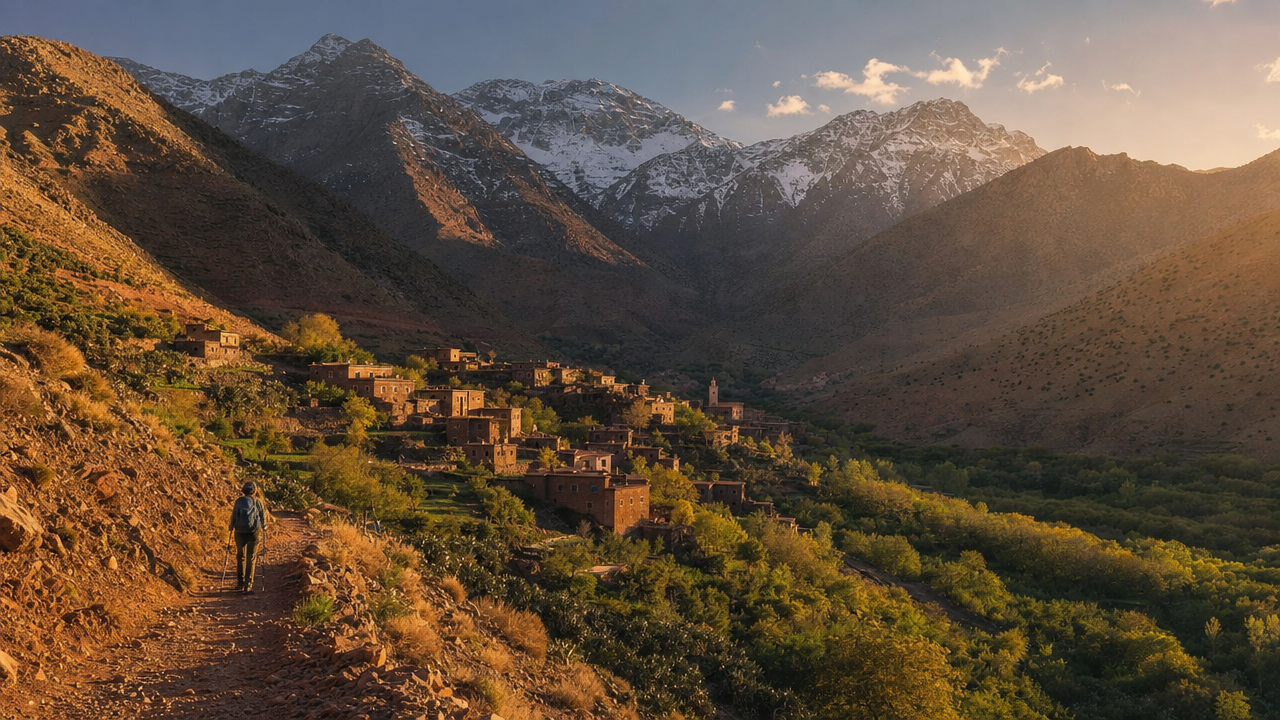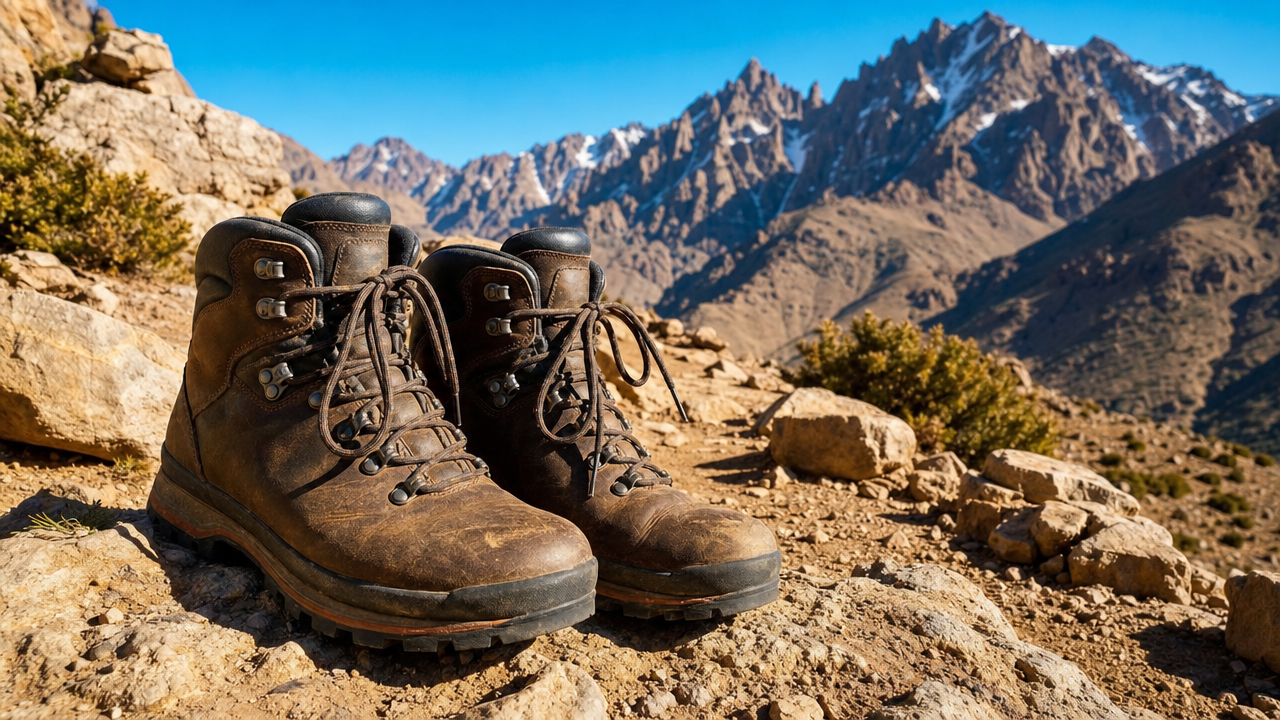
You can have the best tent, the lightest sleeping bag, and the most expensive backpack in the world, but if your boots don't fit and your feet are destroyed by day two, none of it matters. The Atlas Mountains punish bad footwear choices. Loose scree slopes, sharp limestone, river crossings, and long stretches of hard-packed piste — every trail throws a different surface at you, often in the same day.
I've spent the last six seasons guiding and trekking in Morocco's High Atlas, and I've seen every kind of boot failure. Blisters that ended trips on day three. Soles that delaminated on a descent from Toubkal. Ankle rolls that could have been prevented with a stiffer shank. And I've also seen what works.
This guide covers the four boot types that actually make sense for the Atlas, with specific models I've tested on the ground. No Amazon roundups, no theory. These are boots I've worn on Moroccan trails.
What Makes a Good Atlas Mountain Boot
Before we get into specific models, here's what the Atlas terrain demands from a boot that a typical European or North American hiking trail doesn't.
Sole stiffness. The High Atlas is rocky. The trails are not groomed. You'll be walking on fist-sized loose stones for hours at a time, and a flexible sole will leave your feet bruised and exhausted by midday. You need a boot with a nylon or steel shank — something that gives you torsional rigidity under load. If you can bend the boot in half with your hands, leave it in the shop.
Ankle support. Not the cartoonish "my boot goes up to my knee" kind, but a solid ankle collar that locks your heel in place and resists lateral roll on uneven ground. The switchbacks on the Toubkal route are cut at a steep angle, and a loaded pack (15-18 kg with water) will push you off-camber on every step. A low-cut shoe on that terrain is an injury waiting to happen.
Outsole grip. The Atlas is a mix of dry granite slabs, loose scree, and hard-packed earth. A Lugged Vibram sole with deep, widely spaced lugs clears mud and sheds stones better than a tight-tread design. Avoid boots with soft rubber compounds (like Vibram MegaGrip) on the Atlas — they're great on wet European trails but wear down fast on the sharp, abrasive Moroccan rock.
Heel brake. Not a feature you hear about in marketing, but critical on long descents. A good boot has a small heel ledge — a flat spot at the back of the heel — that lets your foot "brake" naturally on steep downhills without your calf muscles doing all the work.
Heat tolerance. The Atlas can hit 35°C in the valleys during summer, then drop below freezing at 4,000 m at night. Your boots need to handle both without falling apart. Leather boots with Gore-Tex liners are the sweet spot — they breathe well enough for the hot sections and keep your feet warm when the temperature drops above 3,000 m.
Now let's look at the specific boots that deliver on all of these.
1. The All-Rounder: Meindl Bhutan
The Meindl Bhutan is the most common boot you'll see on experienced guides and multi-day trekkers in the Atlas, and for good reason. It's a full-grain leather, B-width boot that walks the line between a trekking boot and a light mountaineering boot about as well as anything on the market.
Price: €280–€320 (approx. 3,000–3,400 MAD)
The Meindl Bhutan is the most common boot on experienced guides and serious trekkers in the High Atlas. Priced between €280 and €320 (approximately 3,000–3,400 MAD), this full-grain leather B-width boot features a Vibram Multigrip outsole whose deep, widely spaced lugs shed stones on sharp limestone and loose scree — the rubber compound survives granite abrasion without wearing down after 200 kilometres. A steel shank provides the torsional rigidity needed for loaded descents with a 15-to-18-kilogram pack, while the Gore-Tex Performance Comfort membrane breathes well at valley temperatures of 32°C yet keeps feet warm above 3,000 metres where nights freeze. At 820 grams per boot in size 42, the Bhutan requires a 60-to-80-kilometre break-in period before the leather softens, so trekkers should not take a fresh pair on a seven-day expedition. The wide toe box accommodates natural foot splay on long descents — a feature many narrow-lasted European boots miss — and the high ankle collar provides lateral support without restricting forward flexion on steep climbs.
What it does well:
The full-grain leather upper is the star. It's thick enough to protect your feet from sharp rocks — you'll feel the impact but the leather takes the abrasion — and it's durable enough to last three or four seasons of regular Atlas use. The Vibram Multigrip outsole is a perfect match for Moroccan terrain: deep lugs that shed stones well, with a rubber compound hard enough to survive granite abrasion without turning into slippers after 200 km.
The steel shank gives you the torsional stiffness you need for loaded descents on scree. The ankle collar is high enough to provide real support but not so high that it restricts forward flexion on steep climbs. The toe box is wide enough for the natural foot splay that happens on long downhill sections, which most narrow-lasted European boots get wrong.
The Gore-Tex lining is the standard Performance Comfort membrane. It breathes well enough for summer trekking in the Atlas valleys (I've worn them in 32°C heat without cooking my feet) and keeps the cold out on summit mornings.
What it doesn't do well:
The break-in period is real. Expect 60–80 km of walking before the leather softens to the point where it feels like a boot rather than a cast. The first two days of a trek in new Bhutans are uncomfortable — not painful, but stiff. Do not take these on a 7-day Atlas trek fresh out of the box.
They're also heavy. 820 g per boot in size 42. That's a lot of weight to lift 3,000 m up to the Toubkal refuge. If you're a fast-and-light hiker who covers ground in trail runners on European terrain, these will feel like anchors.
Verdict for the Atlas: The best one-boot solution for multi-day treks in the High Atlas, especially if you're carrying a full pack. If you're doing the Toubkal circuit, the Mgoun Massif, or any of the longer valley-to-valley crossings, these are the boots to beat.
2. The Lightweight: Salomon X Ultra 4 Mid GTX
The Salomon X Ultra 4 is the boot I reach for when I'm covering ground fast — day hikes, overnighters, or any trip where the route involves more walking than scrambling. It's a mid-height boot that behaves like a trail runner with ankle support.
Price: €160–€190 (approx. 1,700–2,000 MAD)
What it does well:
At 450 g per boot (size 42), the X Ultra 4 is roughly half the weight of the Meindl Bhutan. On a 20 km day in the Ourika Valley, that weight difference is the difference between finishing with energy and finishing wrecked. The weight savings come from the synthetic upper — a mix of textile and PU-coated leather — and the lighter construction.
The Contagrip MA outsole is excellent on dry rock. The lug pattern is aggressive enough for loose scree, though the rubber compound is softer than the Vibram on the Meindl, so you'll see faster wear on abrasive granite. For a season of weekend trips and day hikes, it's fine. For a full season of guiding, you'll need a replacement pair by the end of summer.
The Advanced Chassis — a plastic insert in the midsole — provides enough torsional rigidity to keep your foot stable on uneven ground without the weight of a full steel shank. The heel lock is excellent: the SensiFit system wraps the midfoot tightly, and the quick-lace system (which some people love and some hate) lets you dial in the fit precisely.
What it doesn't do well:
The softer rubber outsole wears fast on sharp Moroccan rock. After 300 km of Atlas trails, the lugs on my pair were noticeably rounded, and the grip on loose-over-hardpack terrain had degraded significantly.
The synthetic upper is less protective than leather. On scree slopes, you'll feel sharp rocks through the fabric that a leather boot would simply deflect. This isn't a problem on well-trodden trails, but if you're doing any off-trail scrambling or cross-country routes, a leather boot is safer.
The ankle support is adequate for a loaded day pack (8–10 kg) but not for a full expedition load (15–18 kg). The collar is lower and softer than the Meindl or Lowa, and on a steep, loaded descent, you'll feel the extra work your ankles are doing.
Verdict for the Atlas: Perfect for day hikes from Imlil, overnighters to the Toubkal refuge, and trekkers who value speed over load capacity. Not suitable for multi-day expeditions with a heavy pack or routes with significant off-trail scrambling.
3. The Budget Pick: Decathlon MH500 (Forclaz)
If you're on a tight budget or testing the waters with your first Atlas trek, the Forclaz MH500 from Decathlon is the best value hiking boot in Morocco. It's not the best boot on this list — it's the best boot at its price point, and by a wide margin.
Price: €55–€70 (approx. 600–750 MAD, available in Decathlon Morocco)
What it does well:
The price is the headline. At under 700 MAD, these boots cost less than a single night in a guided Toubkal trip. And unlike most budget boots, they're not terrible.
The rubber outsole is a Decathlon in-house design called "Ice & Trail" — it's not Vibram, but it's surprisingly effective on dry rock. The tread pattern is simple but functional, with deep lugs that clear mud well. The sole is stiff enough for a 3–4 day trek with a moderate pack; there's a basic shank that provides enough rigidity to prevent foot fatigue on rocky trails.
The synthetic upper is waterproof (Decathlon's Novadry membrane) and reasonably breathable for the price. The ankle collar is mid-height and provides basic support — not as good as the Meindl or Lowa, but better than a trail runner.
The fit is forgiving. The MH500 runs wide, which is great for Moroccan trekkers who often need a wider toe box than standard European lasts provide. If you have wide feet, this might be the most comfortable boot on this list for you right out of the box.
What it doesn't do well:
Durability is the trade-off. The sole is glued, not stitched, and the glue joint between the upper and the sole is the weakest point. After 400–500 km of Atlas terrain, the sole will start to separate at the toe. You can get it re-soled by a cobbler in Marrakech for about 100 MAD, but the upper won't hold up for a second re-sole.
The ankle support isn't sufficient for a heavy pack (15+ kg) on technical terrain. If you're doing the Toubkal summit route with a loaded overnight pack, you'll want a stiffer boot. For a day hike or a lodge-to-lodge trek where you're only carrying a day pack, it's fine.
The waterproof membrane is adequate but not Gore-Tex. In wet conditions — crossing the irrigation channels (séguias) that crisscross the Atlas valleys, or walking through wet snow above 3,000 m — your feet will eventually get wet.
Verdict for the Atlas: The best budget option for first-time trekkers, day hikers, and anyone who needs a boot for a single trip. Buy them, wear them for a season, and if you fall in love with Atlas trekking, upgrade to the Meindl or Lowa for your next trip.
4. The Expedition Boot: Lowa Camino
The Lowa Camino is a serious boot for serious terrain. It's the boot you buy when you know you're going to spend multiple weeks in the high mountains, carrying a full pack, and you need something that will hold up for years.
Price: €300–€360 (approx. 3,200–3,850 MAD)
What it does well:
The Camino is built like a tank. The nubuck leather upper is 2.8 mm thick — noticeably thicker than the Meindl Bhutan's 2.0 mm leather — and it's mounted on a split leather sole with a PU midsole that provides exceptional shock absorption. The Vibram "Roccia" outsole is the same compound used on serious mountaineering boots, with a deep, aggressive tread that bites into loose scree and soft dirt equally well.
The steel shank is full-length, giving you the torsional stiffness to carry a 20 kg pack down steep, loose terrain without your feet feeling unstable. The "Monowrap" frame — Lowa's external exoskeleton design — wraps around the heel and midfoot, locking your foot in place and preventing the lateral roll that causes ankle injuries.
The Camino is also resoleable. The sole is stitched and glued, and Lowa supports resoling through authorized dealers. A boot that costs €320 today will cost you €80–€100 to resole in three years and will last another 5–7 years. That's a lifetime boot for most trekkers.
What it doesn't do well:
The weight. At 920 g per boot in size 42, the Camino is the heaviest boot on this list. On flat valley trails, you'll feel every gram. On long, gentle sections — the approach to the Tizi n'Toubkal pass, for example — the extra weight fatigues your legs faster than a lighter boot would.
The stiffness is also a liability on non-technical terrain. The Camino is designed for steep, rocky, exposed ground. On a flat piste or a graded path, the boot feels rigid and unresponsive. You don't want to walk 20 km of valley floor in these every day.
The last is narrow. Lowa's European fit is noticeably tighter than Meindl, especially in the toe box. If you have wide feet, try the Camino on before buying, or size up half a size and wear thicker socks.
Verdict for the Atlas: The expedition boot for trekkers who are doing extended traverses, remote routes, or carrying heavy loads. If you're planning a 14-day crossing of the High Atlas from Imlil to the Mgoun Massif, this is the boot. If you're doing weekend trips from Marrakech, it's overkill.
Which Boot Should You Choose for the Atlas?
The right boot depends on the trip you're planning, not the boot you think looks coolest.
Day hikes and overnighters (1–2 days, day pack to 10 kg): Go with the Salomon X Ultra 4. Light, fast, comfortable. The ankle support is enough for a moderate load, and the weight savings make every kilometer easier.
Multi-day treks (3–7 days, 12–16 kg pack): The Meindl Bhutan is the sweet spot. Stiff enough for loaded descents, comfortable enough for long valley days, and durable enough for a full season of Atlas use.
Extended expeditions (7+ days, 16–20 kg pack, remote terrain): The Lowa Camino. The extra weight is worth it when you're carrying a full load on technical terrain for days on end.
First trek / budget trip / test run: Decathlon MH500. Buy them in Marrakeck, wear them for one trip, and upgrade if you're hooked.
Trail runners are not recommended for the Atlas unless you're an experienced ultra-runner who knows exactly what you're doing. The terrain is too sharp, the descents are too long, and the ankle injury risk on loose scree with a loaded pack is too high.
How Do You Break in Atlas Hiking Boots?
This is the most important section for anyone planning an Atlas trek. The High Atlas has no flat sections that let you ease into a new boot. Every trail starts with a climb — usually a steep, rocky one.
Timeline: Start breaking in new boots at least 4–6 weeks before your trip. Wear them for short walks (2–3 km) around town, then gradually increase to longer walks with a loaded pack. The goal is 60–80 km of walking before the boot feels like it belongs to your foot.
The hotel trick: If you're arriving in Marrakech with new boots, wear them around the medina for a day before heading to the mountains. The flat, hard-packed streets of the medina are surprisingly good for softening leather, and the 10–15 km of walking you'll do in a day of exploring the souks counts as break-in mileage.
Don't use the "water soak" method (soaking boots in water and wearing them dry). It ruins the leather and damages the Gore-Tex membrane. Slow, consistent wear is the only reliable way to break in leather boots.
Wear the socks you'll use on the trek. Don't break boots in with thin liner socks and then switch to thick trekking socks on the trail. The boot molds to the sock thickness.
Where to Buy in Morocco
Marrakech — Decathlon Marrakech (M'Assalam): The best place to buy budget and mid-range boots in Morocco. The MH500 is always in stock, and they occasionally carry Salomon boots. Prices are the same as Europe (around €55–€70 for the MH500). Address: Route de Casablanca, M'Assalam.
Marrakech — Au Vieux Marrakech (Rue Bab Doukkala): A dedicated outdoor gear shop in the medina that stocks Meindl, Lowa, and Salomon. Prices are slightly higher than European retail (expect to pay 10–15% more), but you can try on the boots and buy them immediately. The staff are knowledgeable about local conditions.
Online for Morocco: Avito.ma has a surprisingly good selection of used and new hiking boots. Many European trekkers sell their gear after a trip, and you can find Meindl Bhutans in good condition for 1,500–2,000 MAD. Just check the photos carefully for sole wear.
European purchase (before your trip): If you're coming from Europe, buy your boots before you arrive. You'll have a better selection, better prices, and — most importantly — time to break them in at home. The Meindl Bhutan and Lowa Camino are both available at Bergfreunde, Alpinstore, and Globetrotter.
Final Thoughts
The Atlas Mountains demand respect for your footwear. The trails are harder on boots than any European or North American terrain I've experienced — the sharp limestone, the loose scree, the long, steep descents, and the heat all combine to punish shoes that aren't up to the job.
If you're planning a trip to the High Atlas, start with the Atlas Mountains Trekking Guide for an overview of routes and seasons. Then check our packing list for the Atlas Mountains for the full gear rundown.
The best boot for the Atlas is the one that fits your foot, your trip, and your budget. The four options above cover the range from a weekend trip to a full expedition. Pick the one that matches your trip, break it in properly, and your feet will thank you on the descent from Toubkal.
For more on Morocco's best hiking trails, see our guides to hiking trails in Morocco and Toubkal National Park's rocky trails. And if you're planning a longer stay, our Morocco's High Atlas destination guide covers everything from permits to accommodation.
Recommended Gear
We may earn a commission if you purchase through these links, at no extra cost to you. We only recommend products we genuinely use and trust.
Meindl Bhutan MFS
MeindlStiff-soled leather boots ideal for High Atlas scree slopes and rocky terrain. The gold standard for Moroccan mountain trekking.
~$350-$450Lowa Renegade GTX
LowaMid-cut waterproof boot with excellent ankle support. Versatile enough for both coastal trails and mountain treks.
~$230-$280Salomon X Ultra 4 GTX
SalomonLightweight mid-cut boot that performs well on mixed terrain. A good choice for Algarve coastal trails.
~$180-$220