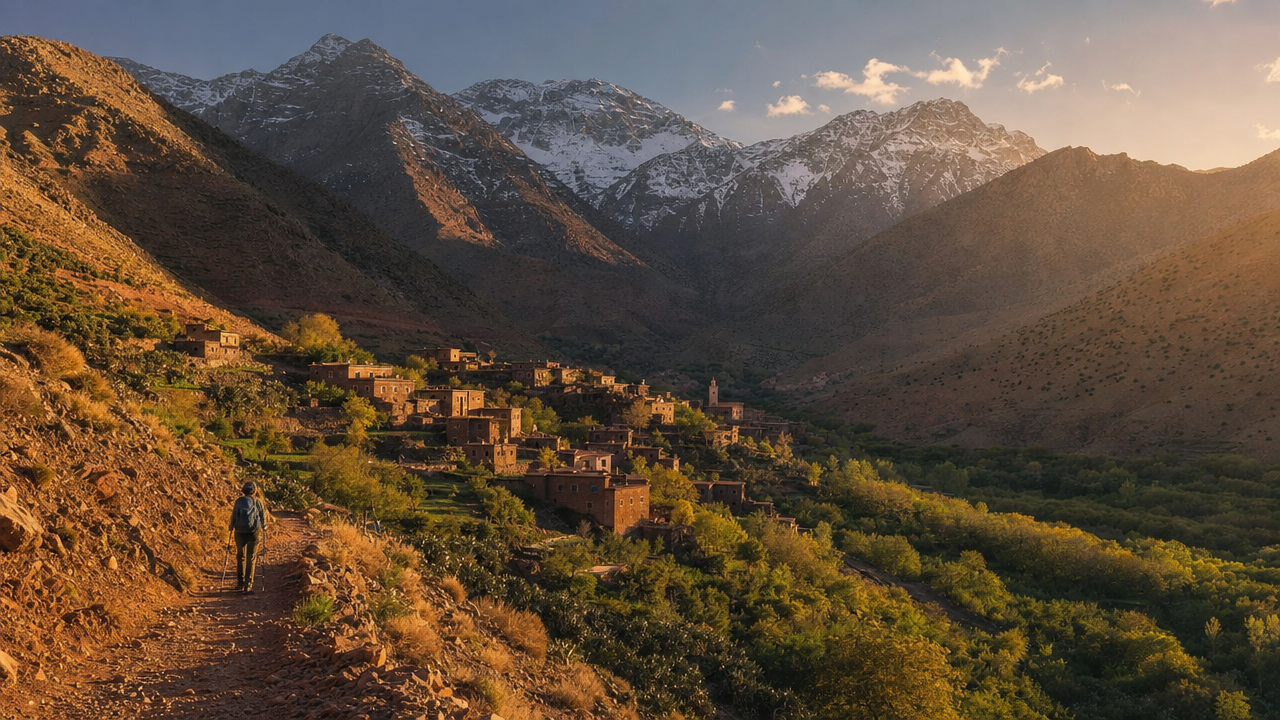
Marrakech is one of the best launchpads for outdoor adventure in North Africa. Ninety minutes south-west of the city, the High Atlas rises to 4,000-metre peaks. Forty-five minutes north-west, the Agafay Desert stretches in a lunar plain of stone and sand. In between are river valleys, mountain lakes, and hidden swimming holes that most visitors never see.
Most people come to Marrakech for the medina, the souks, and the nightlife in the Palmeraie. They leave without ever seeing what's an hour outside the city limits. That's a mistake. Marrakech's real magic isn't in the city — it's in the mountains and deserts that surround it.
This guide covers the best outdoor activities near Marrakech, with specific routes, logistics, and seasonal advice for each one.
Hiking in the High Atlas
Toubkal via Imlil — The Classic Summit
The Toubkal summit (4,167 m) is the highest point in North Africa and the most iconic hiking objective near Marrakech. It's a serious mountain — not a walk in the park — but it's achievable for anyone with good fitness and a willingness to suffer a bit at altitude.
The gateway: Imlil, a mountain village 65 km and roughly 90 minutes from Marrakech by car. You can take a grand taxi from the Bab er Robb taxi rank in Marrakech for about 250–300 dirham per person, or hire a private driver for 400–500 dirham. The road is paved all the way to Imlil, though the last 15 km are winding mountain switchbacks.
The route: Most trekkers do the Toubkal climb as a two-day itinerary. Day one starts in Imlil (1,740 m), follows the Mizane Valley past the villages of Armed and Sidi Chamharouch (a small stone shrine with a waterfall), then climbs to the Toubkal Refuge (3,207 m). The hut is run by the Club Alpin Français and offers dormitory beds, blankets, and basic meals. Expect to share a room with 20 other climbers. The second day starts early — 4:30 am — to summit before the clouds roll in, then descends back to Imlil in the afternoon.
The day-one climb from Imlil to the refuge gains 1,467 m over roughly 12 km. It's a steady gradient on a well-defined trail, but the altitude will slow you down. Most people take 5–6 hours with a loaded day pack. The summit day is 977 m of ascent from the refuge, followed by a knee-punishing 2,427 m descent back to Imlil. Total distance over two days is roughly 30 km.
Seasonal advice: The best time for Toubkal is April to October. May and June are ideal — the snow has retreated from the main trail, the valleys are green with wildflowers, and temperatures are comfortable for climbing. July and August are hot in the valleys (35°C+) but manageable at altitude. September and October offer stable weather and golden autumn colours. November to March brings snow to the upper mountain. The summit route from the refuge is a snow climb in winter, requiring crampons and an ice axe. Unless you have winter mountaineering experience, stick to the summer season.
What to know: Altitude affects everyone differently. The refuge sits at 3,207 m — high enough to cause headaches, nausea, and disrupted sleep. Spend a night in Imlil (1,740 m) before starting your trek to give your body a day to acclimatise. Drink 3–4 litres of water on summit day. And hire a guide — the trails are well-marked, but a local guide adds safety, logistics, and cultural context. The official rate for a certified mountain guide is about 500–600 dirham per day.
Ourika Valley — Day Hikes and Waterfalls
The Ourika Valley is the closest mountain escape from Marrakech — about 45 minutes from the city centre. It's a lush, green valley cut by the Ourika River, with terraced fields, walnut groves, and Berber villages clinging to the hillsides.
Setti Fatma waterfalls are the main attraction. The trail starts at the end of the road in Setti Fatma village and climbs through a series of seven waterfalls over about 2–3 hours. Each cascade is larger than the last, and you can swim in the pools at the base of the lower falls. The trail is steep in sections — there are some exposed rock faces where a chain handrail is bolted into the cliff — but it's doable in trainers. The best time to visit is spring (March to May) when the snowmelt fills the river and the waterfalls are at their most dramatic.
The valley itself offers excellent day hiking. Follow the trail past the waterfalls into the upper valley, where the crowds thin out and you're walking through traditional Berber farmland. The round trip from Setti Fatma to the top of the valley is about 8–10 km with 400–500 m of elevation gain.
Getting there: Grand taxis leave from the Bab er Robb taxi rank in Marrakech. The fare is about 150–200 dirham for a shared taxi, or 350–400 dirham for a private car. The road follows the valley and ends at Setti Fatma. You can also drive yourself — the road is paved and in good condition, though narrow in places.
Practical tip: Go early. The Ourika Valley is popular with Moroccans on weekends and European tourists year-round. Arrive at Setti Fatma by 9:00 am to beat the crowds. Bring a swimsuit for the pools, and keep your valuables in a dry bag — the waterfall spray soaks everything.
Tizi n'Test Pass — High Mountain Crossing
The Tizi n'Test pass (2,100 m) is a high mountain crossing that connects Marrakech to the Souss Valley and Taroudant. The drive is one of Morocco's most spectacular mountain roads, with switchbacks that climb through pine forests and alpine meadows before dropping into a semi-desert landscape on the far side.
But the pass is also a fantastic hiking destination. Several trails start from the pass and follow ridgelines into the surrounding peaks, offering panoramic views of the Toubkal Massif to the north and the Anti-Atlas to the south. The walking is moderate — rolling ridges with 300–500 m of climb — and the trails are quiet. You'll see shepherds and their flocks, but very few other hikers.
Getting there: The pass is about 80 km from Marrakech via the R203 road. A grand taxi costs about 300–400 dirham. The drive takes 1.5–2 hours depending on traffic. If you're not comfortable with mountain driving, hire a driver rather than renting a car — the road has steep drops with limited guardrails in sections.
Seasonal advice: The Tizi n'Test is accessible year-round, but winter can bring snow that closes the pass for short periods. Spring (March–May) is ideal for hiking — the wildflowers are out and the temperatures are mild. Summer hiking is possible if you start early and carry plenty of water.
Desert Camping
Agafay Desert — Luxury Camping Under the Stars
The Agafay Desert is a stony desert plain about 45 minutes from Marrakech. It's not a sand desert — think more of a Martian landscape of grey stone, ochre earth, and sparse scrub — but it's the closest desert camping experience to Marrakech, and it's spectacular in its own right.
Several desert camps operate in Agafay, ranging from basic tent setups to full luxury glamping with proper beds, hot showers, and Moroccan cuisine under the stars. The best experience is a night spent in a traditional Berber tent (khaima) with a dinner of couscous, tagine, and grilled meat cooked over an open fire, followed by stargazing in some of the clearest skies in Morocco.
What to do: The main activities in Agafay are quad biking, camel riding, and hiking across the stone plateau. The terrain is open and easy to walk — you can follow dry riverbeds (wadis) and explore abandoned settlements. The sunset is the highlight of the day, when the grey stone turns pink and gold. After dark, the sky is dark enough to see the Milky Way clearly with the naked eye.
Getting there: Most Agafay camps include transfer from Marrakech in their package. The drive takes 45 minutes via the R203 road toward Asni. If you're driving yourself, the main camp turnoffs are signposted from the road.
Cheaper alternative: If you want to camp independently, you can bring your own tent and camp anywhere in the Agafay — it's open public land. But bring your own water (there's none on the plain), and be prepared for cold nights. The desert temperature drops dramatically after sunset, even in summer.
Jbel Takerkoust — Lake Camping and Water Sports
Jbel Takerkoust is a reservoir lake about 45 minutes from Marrakech, created by a dam on the N'fis River. It's a different kind of camping — lakeside, with water sports and a relaxed atmosphere.
The setup: Several camps and guesthouses line the north shore of the lake, offering tent camping, glamping, and cabin accommodation. The water is warm enough for swimming from June through September. Kite-surfing and windsurfing are popular — the lake catches consistent wind in the afternoon. You can rent equipment at the lake or bring your own.
What to do: Camping at Takerkoust is about slowing down. Swim, paddle, read, and eat grilled fish at one of the lakeside restaurants. The sunsets over the dam are beautiful. There are also hiking trails on the hills above the lake — short walks that take 1–2 hours and offer views over the water and the distant Atlas peaks.
Getting there: Take the R203 road from Marrakech toward Asni, then follow the signs for Jbel Takerkoust. The drive takes about 45 minutes. A grand taxi costs around 200–250 dirham.
Paradise Valley — Swimming and Picnicking
Paradise Valley (Vallée du Paradis) is a series of natural swimming pools carved into a narrow gorge about 30 km north of Agadir — about 2.5 hours from Marrakech. It's a day trip, not an overnight, and it's one of the best swimming spots in Morocco.
The valley is a lush green corridor of palm trees, oleander, and fig trees, with crystal-clear water flowing through a series of rock pools. The largest pool is about 15 metres wide and deep enough to dive into. The smaller pools upstream are quieter — you can spend an afternoon swimming, sunbathing on the smooth rock slabs, and eating a picnic lunch.
The route: Park at the village of Imouzzer Ida Outanane, then follow the trail into the gorge. The walk takes about 20 minutes from the car park to the first pool. The trail follows the river and requires some easy scrambling over rock. Wear sandals with a good sole — the rocks are smooth and slippery.
Seasonal advice: Visit between April and October for swimming. In winter and early spring, the water is cold (12–15°C) and the flow can be too strong for safe swimming. Summer weekends are busy — go on a weekday if you can.
Getting there from Marrakech: This is a longer trip. Drive yourself or hire a private driver for the day. The route follows the A7 motorway south toward Agadir, then takes the N1 toward Aït Baha. Total driving time is 2–2.5 hours each way. It's a full-day trip: leave Marrakech at 7:00 am, arrive by 9:30, swim and picnic until 2:00 pm, and drive back.
Seasonal Planning Guide
Morocco's outdoor seasons are sharply defined, and timing your trip around the right season makes the difference between a great adventure and a miserable one.
| Activity | Best Season | Notes |
|---|---|---|
| High Atlas hiking (Toubkal, Tizi n'Test) | April–October | Avoid mid-summer (July–August) for low-altitude hikes; summit trails are fine year-round with proper gear |
| Ourika Valley hiking | March–June (waterfalls at peak flow) | September–October also good but water levels lower |
| Desert camping (Agafay) | October–April | Summer is too hot for comfortable camping — daytime temps exceed 45°C |
| Lake camping (Takerkoust) | June–September | Water sports season; October–May for hiking and camping but too cold for swimming |
| Paradise Valley swimming | April–October | Peak swimming season is June–September |
| Stargazing (Agafay) | October–April | Clearer skies, cooler nights, no summer haze |
Summer (June–August): Hiking at altitude is still good, but valley hiking becomes brutal. Desert camping is not recommended. This is the best time for lake activities and swimming.
Autumn (September–October): The sweet spot. Pleasant temperatures across the board, stable weather, and lower tourist numbers than spring. Hiking, camping, and swimming are all good.
Winter (November–February): High Atlas trekking requires cold-weather gear and snow experience. Desert camping is excellent — cool days and cold nights. Ourika Valley hiking is fine in the lower sections.
Spring (March–May): Wildflowers, full rivers, and moderate temperatures. The best all-round season. Book accommodation in advance — this is peak season for European tourists.
Practical Tips for Outdoor Activities Near Marrakech
Getting around: Grand taxis (shared Mercedes sedans) are the default transport option for most outdoor destinations. The Bab er Robb taxi rank in Marrakech's medina is the main hub for mountain and desert taxis. Fares are negotiable but fixed routes exist — ask at the rank or your riad for the current rate. For day trips, hire a private driver through your accommodation (expect 400–700 dirham for a full day).
Guides: For any hike above 3,000 m, hire a certified mountain guide. The Association des Guides de l'Atlas (AGA) in Imlil maintains a roster of qualified guides. Rates are standardised at 500–600 dirham per day. For desert trips, guides are less essential — the Agafay camps operate their own programmes.
Gear: You don't need to bring everything from home. Decathlon Marrakech (at the M'Assalam shopping centre) stocks hiking boots, backpacks, camping stoves, and sleeping bags at European prices. For technical gear — mountaineering boots, crampons, ice axes — rent in Imlil or from a guide.
Water: Tap water is not drinkable in Morocco. Buy bottled water in Marrakech before heading to the mountains. Expect to carry 2–3 litres per person for a day hike. For multi-day treks, your guide or muleteer will arrange water supplies.
Cash: Bring enough cash from Marrakech — ATMs are non-existent once you leave the city. Grand taxi drivers, guides, and small village shops only accept cash.
What to pack:
- Sturdy hiking boots with good ankle support
- Layers — temperatures vary 20°C between valley and summit
- Sun hat, sunglasses, and high-SPF sunscreen
- Head torch (for early summit starts and night walks)
- Swimwear (for Ourika Valley and Paradise Valley)
- Insulated jacket for evenings (even in summer)
- Dry bags for electronics and valuables
Safety: Morocco is a safe country for outdoor activities, but take standard precautions. Don't walk alone on remote trails. Register your trek with a guide or accommodation. Check the weather forecast before heading into the mountains — flash floods are a real risk in the Ourika Valley after heavy rain.
The Final Word
Marrakech's greatest asset as a travel destination is not the Djemaa el-Fna or the Bahia Palace. It's the position — a city that sits at the foot of Africa's highest mountain range, within striking distance of the Sahara, and surrounded by valleys, gorges, and lakes that most of its visitors never discover.
The best outdoor activities near Marrakech don't require long transfers or expensive equipment. They require a willingness to leave the medina for a day or two. The Atlas Mountains are waiting. The desert is waiting. And the best experiences — standing on the summit of Toubkal as the sun rises over the Sahara, swimming in a rock pool in Paradise Valley, or lying on a mat in the Agafay watching the Milky Way arc overhead — cost nothing but the effort to get there.
Start with the High Atlas hiking routes or the Agafay Desert camp, and work your way out from there. You won't regret it.