Taghazout sits at the centre of Morocco's Atlantic surf coast, but the outdoor scene here runs much deeper than the famous point breaks. Within an hour's drive of this small fishing town you'll find hiking trails into the High Atlas foothills, cliffside campgrounds that sleep to the sound of the swell, and some of the most dramatic coastal viewpoints on the continent.
This guide covers the four best outdoor activities near Taghazout and Agadir — surfing, camping, hiking, and coastal viewing — with the practical logistics you need to plan your trip.
Surfing: The Taghazout Break Circuit
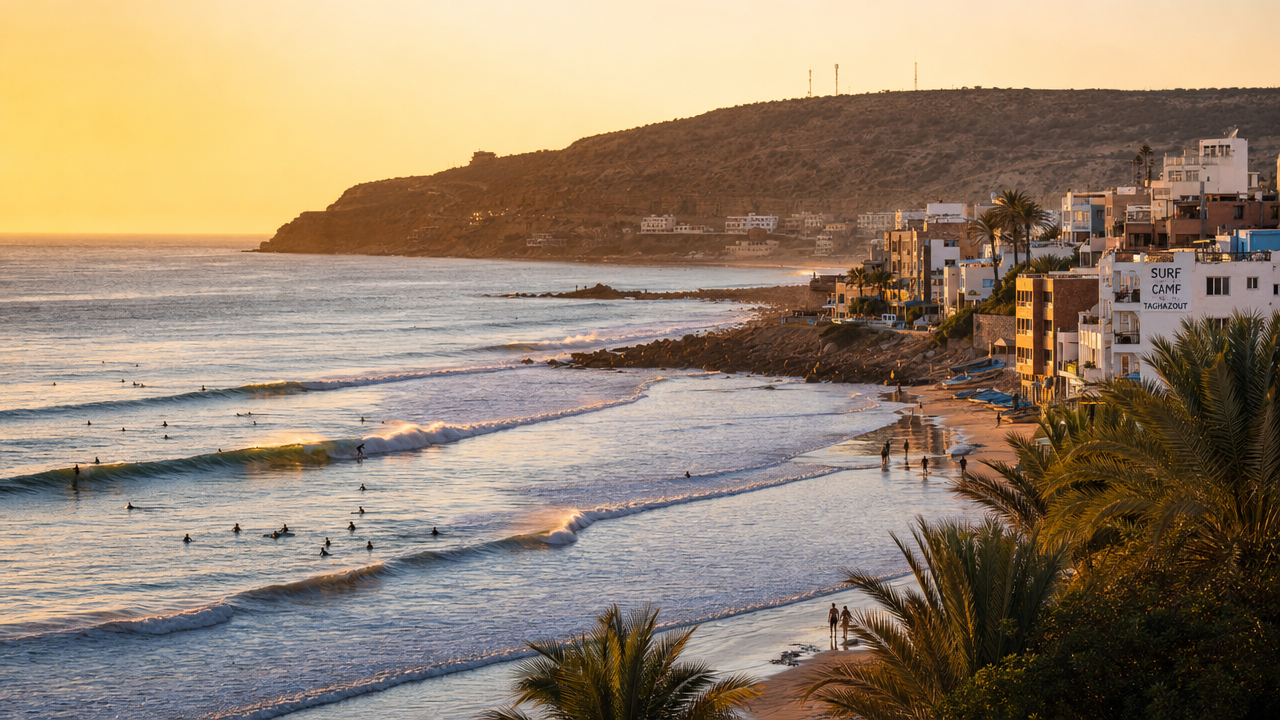
Taghazout's surf reputation is built on a string of point and beach breaks that stretch along a 15-kilometre stretch of coast between the town itself and the village of Tamraght. Each break has its own character, crowd level, and ideal conditions.
Best season: October through April delivers the most consistent swell, with clean groundswells rolling in from the North Atlantic. Water temperature sits at 18–20°C, meaning a 3/2 wetsuit works year-round. Summer (May–September) flattens out, though occasional south swells keep things rideable.
Anchor Point
The crown jewel of Taghazout's lineup. Anchor Point is a long, right-hand point break that peels for 200+ metres off the rocky headland at the southern edge of town. It works best on a solid north-west swell from 1.5 to 3 metres, producing a slow, walled wave that gives you time to set your line and work the face.
The crowd can be thick — 20 to 40 surfers on a good day, with a strong local presence that commands respect in the water. Paddle out at the main peak near the rocks, let the locals take their pick of the sets, and you'll get waves. The wave is forgiving enough for strong intermediates but rewarding enough for advanced surfers to take down the line.
Logistics: A 5-minute walk from central Taghazout. Check the swell direction before committing — Anchor Point goes flat on anything that isn't north-west.
Hash Point
A 10-minute walk north of town, Hash Point is a sand-bottom beach break with peaks that shift along the beach. It's the most beginner-friendly break in the Taghazout area — soft takeoffs, forgiving drops, and a spread-out lineup that never feels crowded.
The wave is shorter than Anchor Point — 50 to 80-metre rides — but it breaks consistently on almost any swell. This is where most surf camps run their morning sessions, and for good reason. The sandbars change with the tides, so local knowledge matters.
What to rent: Most shops on the main road offer foamies for 150 dirham a day. A lesson runs around 250 dirham an hour and is money well spent if you're new to beach breaks.
Crocodile Beach and Banana Point
Crocodile Beach is a rocky reef break that sits between Taghazout and Hash Point. It gets its name from the crocodile-shaped rock formation near the peak. It's a left-hand break that works on south-west swells — a rarity on this coast — and is less crowded than the main points. Not for beginners: the reef is shallow and the takeoff is snappy.
Banana Point is further north, near the village of Tamraght. It's another right-hand point break that wraps around a rocky headland, producing long, peeling waves that are less crowded than Anchor Point. The paddle-out is easier than Anchor Point, and the wave holds up to 2-metre swells. Most surfers who want a ledge without the taghazout crowds base themselves here.
Imsouane: The Bay and The Cathedral
Forty minutes north of Taghazout, the village of Imsouane holds one of Morocco's most remarkable surf setups. The Bay — a 600-metre-long right-hander that peels gently along the edge of a massive natural bay — is the longest rideable wave in Morocco, possibly in all of North Africa. A single wave can carry you for over a minute if you link the sections.
The wave works on a massive swell window and is extraordinarily forgiving. It's a slow, walled wave that rarely closes out, making it one of the best longboard waves on the continent. Beginners can take off, stand up, and ride for 100 metres on their first session. Experienced surfers can work the whole wall from the peak to the inside section.
Next to The Bay is The Cathedral — a shorter, punchier beach break that produces hollow, barrel-shaped waves when the swell is over 2 metres. The two breaks side by side mean Imsouane works for every level on the same tide.
Camping note: The cliffs above The Bay have several informal campgrounds where you can pitch a tent for 50 dirham a night and wake up to a view of the wave you'll surf at sunrise.
Sidi Kaouki
Two hours south of Taghazout (past Agadir and Essaouira), Sidi Kaouki is worth the drive when the north-west swell is too big for the Taghazout points. It's a long, exposed beach break that handles serious swell and produces powerful, wind-blown waves. More importantly, it's one of the best kitesurfing spots on the Moroccan coast.
The wind picks up reliably from March through October, with side-offshore conditions that create clean, choppy kickers for kite jumps. Kite schools line the beach, and gear rental is cheap — expect 400–500 dirham for a full kitesurfing setup for a day.
Camping: Sleeping on the Coast
Camping near Taghazout falls into two categories: organised beachfront campgrounds and wild camps on the cliffs above the better-known surf breaks.
Beach camping near Imsouane
The cliffs above Imsouane Bay are the prime camping ground on this stretch of coast. Several informal sites run by local families have sprung up — flat, wind-sheltered pitches with views down onto the bay. Facilities are basic: a shared toilet, cold outdoor shower, and a small shack selling tea and tagines. Price runs 30–50 dirham per person per night.
The experience is hard to beat. You fall asleep to the sound of the swell, wake up as the sun crests the hills, and walk five minutes down the path to a wave that holds for 600 metres. No hotel can offer that.
Tamraght cliff camps
The headlands around Tamraght — just north of Banana Point — also host informal camping on the cliffs. These spots are less developed than Imsouane but offer spectacular views over the point break. A 4x4 or high-clearance vehicle is recommended for the access tracks.
Paradise Valley bivouac
Paradise Valley — about 25 minutes inland from Taghazout — offers a different kind of camping. The valley is a lush, palm-filled gorge in the foothills of the Anti-Atlas, carved by a year-round river. The local guides run organised bivouac camps with dome tents, dinner around a fire, and guided hikes into the gorge the next day. Expect 300–400 dirham per person for a full day trip including lunch, guide, and transport.
Hiking: Paradise Valley and Beyond
The hills behind Taghazout rise into the Anti-Atlas range, and the hiking here is undervalued. Most visitors never look inland from the surf, but the trails that follow the river valleys into the mountains are some of the most scenic in the region.
Best season: October through April for hiking — the same months as the surf season, which means you can combine a dawn surf session with a midday hike. Summer (May–October) is hot in the valleys but workable if you start early.
Paradise Valley hike
The main draw is Paradise Valley — a 45-minute drive from Taghazout. The hike follows the river upstream through a narrow gorge lined with argan trees, fig trees, and date palms. The trail is easy to moderate, with a few rock-scrambling sections and river crossings.
The reward at the end is a series of natural rock pools carved into the gorge — deep, clear, and cool enough to make the midday heat irrelevant. On a busy day in season you'll share them with a handful of other hikers and the occasional local guide selling almonds and mint tea from a cooler.
Logistics: The turn-off to Paradise Valley is signposted from the main road between Agadir and Taghazout. A shared taxi from Taghazout runs around 150 dirham round trip with a wait. Most guided trips leave around 9am and return by 3pm.
Tamraght-to-Taghazout coastal trail
A less-known option is the coastal trail that runs between Tamraght and Taghazout — about 6 kilometres of cliff-edge walking with views over the full circuit of breaks. The trail is unmarked but easy to follow: start at Banana Point and head south along the cliff edge, passing Crocodile Beach and Hash Point before descending into central Taghazout. Allow 1.5 to 2 hours with photo stops.
Coastal Viewpoints
The coast between Agadir and Taghazout is cut by headlands and rocky points that offer some of the best ocean views in Morocco.
Taghazout headland
The rocky point at the southern end of Taghazout beach — the same formation that creates Anchor Point — is the obvious viewpoint. At high tide the swell crashes into the rocks below the footpath. At low tide you can walk out onto the exposed reef. Sunset from this headland is a ritual worth joining: the sun drops directly into the Atlantic and the Moroccan call to prayer drifts up from the town below.
Tamraght headland
The cliffs above Banana Point in Tamraght offer a wider view of the full coastline — from the Taghazout headland in the south to Imsouane's Bay in the north. The viewing spot is a 10-minute walk from the main Tamraght road and is accessible by any car.
Cap Ghir
About 15 minutes south of Taghazout, Cap Ghir is a rocky headland that juts into the Atlantic. The cliffs here are dramatic — steep, jagged, and home to nesting seabirds. The view south toward Agadir is expansive, and on clear days you can see the port of Agadir and the distant outline of the Atlas Mountains. It's also a popular whale-watching lookout between December and March, when migrating humpback and killer whales pass within sight of the coast.
Logistics: Getting Around
Getting there: Fly into Agadir–Al Massira Airport (AGA). Flights arrive from most major European hubs — London, Paris, Madrid, Brussels — on Ryanair, EasyJet, Transavia, and Royal Air Maroc. From the airport, Taghazout is a 45-minute taxi ride costing 200–300 dirham. A rental car is more flexible: the major international agencies (Europcar, Hertz, Avis) have desks at arrivals, and prices start at around 200 dirham per day for a small hatchback.
Getting around: The Taghazout–Tamraght–Imsouane axis is easiest by rental car or scooter. A scooter costs 100–150 dirham per day and handles the coastal road comfortably. Shared taxis run between the towns but are less frequent outside peak hours.
What to bring: 3/2 wetsuit (surf rentals are available but a good fit matters), hiking shoes or sturdy sandals with tread, sun protection (the Moroccan sun is stronger than you think, even on overcast days), a headlamp for early-morning paddle-outs, and a tent if you plan to camp — the cliff sites don't provide one.
When to Go
The beauty of Taghazout's outdoor scene is that there isn't really a bad season, just a trade-off:
- October to April — Prime surf season (consistent NW swells, 18–20°C water) and comfortable hiking weather (20–25°C daytime). This is the sweet spot for doing everything.
- May to October — Better for hiking (longer days, warmer evenings, wildflowers in Paradise Valley) but the surf drops off. Kitesurfing season at Sidi Kaouki peaks here.
- Winter (December–February) — Surf is at its biggest and most consistent. It's also whale-watching season at Cap Ghir. Nights are cool (10–15°C) but days are sunny and pleasant.
For the traveller who wants to surf, hike, camp, and explore the coast in a single trip: October and November deliver perfect conditions across all four activities with smaller crowds than the Christmas–New Year rush.
Ready to plan your trip? Taghazout's combination of accessible surf breaks, semi-wild camping, valley hiking, and dramatic coastal viewpoints makes it one of the most complete outdoor destinations on the Atlantic coast. Pick your season, pack for both water and land, and give yourself at least a week to work through everything on this list.