Barcelona sits in a geographic sweet spot that few European cities can match. To the west, the Collserola hills rise green and close — hiking trails start within 8 km of the city centre. To the north, the Costa Brava's coves and campsites stretch toward France. Inland, the jagged pinnacles of Montserrat rise out of the Catalan plain, an hour by train from Barcelona-Sants. And within the city itself, a handful of elevated viewpoints give you the Mediterranean coastline from a different perspective every evening.
I've spent the better part of two years exploring this stretch of Catalonia on foot, by train, and by rental car. This guide covers the best outdoor activities within easy reach of Barcelona — hiking, camping, viewpoints, and the logistics that make each one work.
When to Go: Spring and Autumn
The best seasons for outdoor activities near Barcelona are spring (March–May) and autumn (September–November).
Spring brings wildflowers to Collserola and the Montserrat foothills, comfortable hiking temperatures (16–22°C), and campsites on the Costa Brava that reopen after winter. Autumn is even better for hiking and viewpoints — the Mediterranean light turns golden, the summer crowds have gone, and the sea is still warm enough for a September swim between hikes.
Summer (June–August) is feasible if you start early — trails should be done by 10 am to avoid the 30°C+ midday heat, and Costa Brava campsites book out weeks in advance. Winter (December–February) is quiet and cool; Collserola and Montjuïc remain walkable year-round, but Montserrat's higher trails can be icy, and most Costa Brava campsites close until March.
Hiking: Collserola Natural Park
Collserola Natural Park is Barcelona's backyard — 8,000 hectares of Mediterranean forest rising to 512 metres at Tibidabo, all within the city limits. The park has over 100 km of marked trails, and the closest trailhead (Parc de l'Oreneta) is reachable by metro from Plaça Catalunya in under 30 minutes.
Best Trail: Carretera de les Aigües
- Distance: 11 km one way (out-and-back or point-to-point)
- Elevation gain: 250 m
- Difficulty: Easy–Moderate
- Season: Year-round (best March–May, September–November)
- Start point: Any point along the ridge — most people start from the Torre de Collserola viewpoint
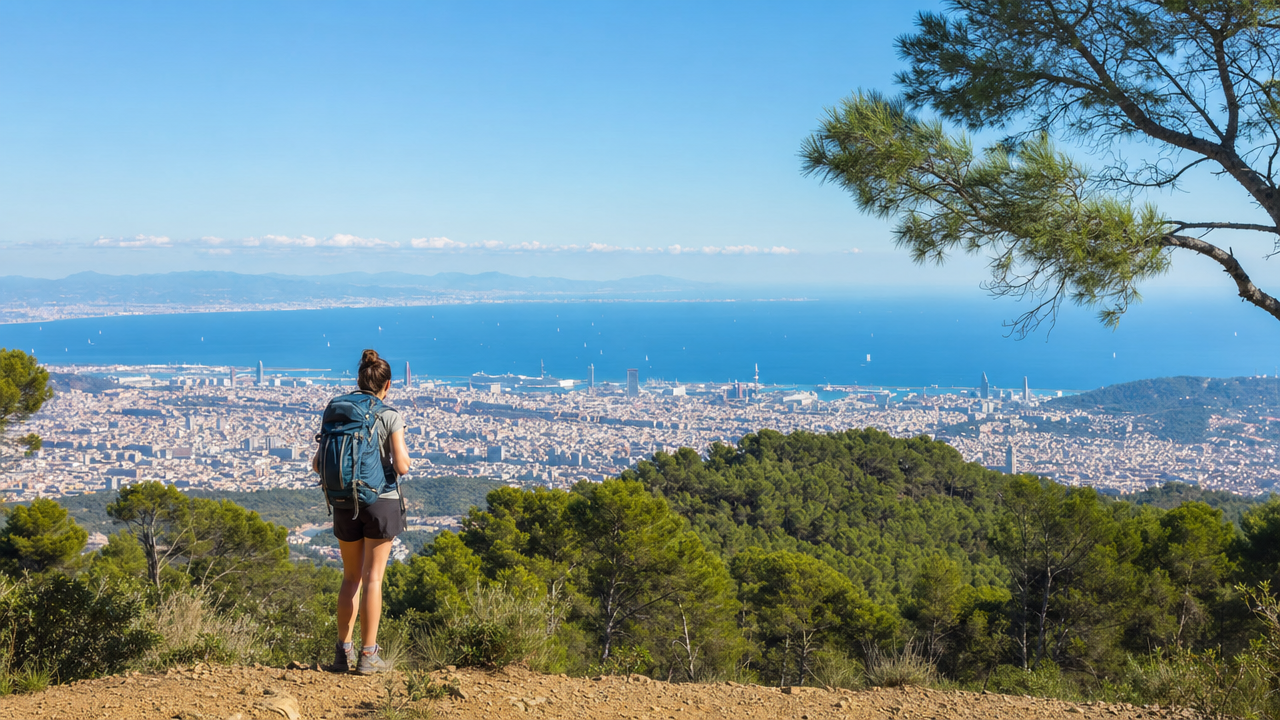
The Carretera de les Aigües is a former water-service road that traces the Collserola ridge at roughly 350–400 metres elevation. It runs nearly flat along the park's southern slope, with continuous views of Barcelona, the Mediterranean, and on clear days, the Serra de Tramuntana in Mallorca. The surface is packed gravel — suitable for running, trail walking, and mountain biking.
Walk it east from the Torre de Collserola toward Sant Pere Màrtir (5.5 km each way). The first 2 km are the most exposed and offer the best views — the city stretches out below, from the port to the Sagrada Família, with the coastline curving away toward the Maresme. In spring the rosemary and lavender along the trail edges are in full scent.
Logistics: Take the S1 or S2 train from Plaça Catalunya to Peu del Funicular (20 minutes), then the funicular up to the Tibidabo amusement park. From Tibidabo it's a 500-metre walk through the park to the Torre de Collserola and the trailhead. Alternatively, the V15 bus from Plaça Catalunya to the Tibidabo funicular station works the same route. Return by bus from the Vallvidrera viewpoint at the western end.
Alternative for a shorter option: The Font del Bacallà loop — 4.5 km, 150 m gain, easy — starts from the Baixador de Vallvidrera train station (25 minutes from Plaça Catalunya on the S1/S2). It follows a stream through oak and pine forest, past a 19th-century spring-fed fountain, and returns via a gentle ridge path with views over the Llobregat valley.
Montserrat: The Iconic Day Hike
Montserrat's serrated rock formation is Catalonia's most recognisable natural landmark — a cluster of sandstone pinnacles that rises abruptly from the plain 50 km northwest of Barcelona. The monastery at its base has been a pilgrimage site for a thousand years, but the real draw for hikers is the network of trails that climb the peaks above it.
Getting there by train: Take the R5 line from Barcelona-Sants to Aeri de Montserrat (1 hour, 40 minutes). From the station, the aerial cable car (Aeri de Montserrat) takes 5 minutes to reach the monastery — or you can take the Cremallera rack railway (Sant Joan or Santa Cova lines) for connecting trailheads. Return trains run hourly until late afternoon. The round-trip cost for train + cable car is approximately €25–30.
Getting there by car: Take the A-2 motorway toward Lleida, exit at Olesa de Montserrat, then follow signs to the monastery (BV-111 road). Parking at the monastery costs €6.50 per day. Weekend mornings fill by 9:30 am.
Best Trail: Sant Jeroni Summit
- Distance: 6 km round trip
- Elevation gain: 500 m
- Difficulty: Moderate–Hard
- Season: March–May, September–November (ice possible on upper sections in winter)
- Start point: Monastery esplanade (follow signs for Via Crucis, then Sant Jeroni)
The trail to Sant Jeroni (1,236 m), Montserrat's highest point, starts behind the monastery and climbs steadily through the rock formations. The path is well-marked and partly carved into the rock itself, with iron handrails on the steeper sections. The final 200 metres involve a short chain-assisted scramble — full exposure but perfectly secure with dry rock.
The summit is a small platform with 360° views: the Pyrenees to the north (often snow-capped in spring), the Catalan plain to the south and west, and on clear days, the Mediterranean and Mallorca's Serra de Tramuntana. The view alone justifies the train journey from Barcelona.
Moderate alternative: The Camí de la Santa Cova — 4 km return, 200 m gain — follows a cliff-side path past chapels and viewpoints, through several short tunnels and a walkway pinned to the rock face. It's the most accessible trail on Montserrat and gives you the mountain's drama without the summit scramble.
What to know: Montserrat's trails dry quickly after rain, but hold ice in shaded sections through January. Check the trail status at the information office in the monastery before heading up. Bring at least one litre of water — there are no reliable sources above the monastery level.
Camping: Costa Brava
The Costa Brava coastline north of Barcelona is one of Europe's best camping destinations — a mix of sandy coves, pine-backed beaches, and campsites that range from basic pitches to full-resort facilities. The main camping zones are the beach towns of Pals, Sant Pere Pescador, and the Cap de Creus peninsula.
Pals
Pals sits on a hill 3 km inland from Platja de Pals — a 2.5 km stretch of fine golden sand backed by dunes and pine forest. The campsites here are family-oriented, most with direct beach access. The best sites include Camping Pals, Camping Playa Brava, and Camping La Siesta, all open from April to October.
What to do here: The beach is the draw — swimming, paddleboarding, and windsurfing (the Tramuntana wind picks up reliably in spring). The GR-92 coastal path runs behind the dunes and connects to the Camí de Ronda, the historic coastguard trail that links the coves between Pals and Begur. The 7 km walk from Pals to Sa Riera cove via the Camí de Ronda is one of the most scenic coastal stretches in Catalonia.
Logistics from Barcelona: Take the train from Barcelona-Sants to Flaçà (1 hour, 15 minutes, from €10), then a bus to Pals (30 minutes). By car, take the C-32 north to the C-31, exiting at Pals (1 hour, 20 minutes).
Sant Pere Pescador
Sant Pere Pescador sits on the northern bank of the Fluvià River, 3 km from the beach. The camping here is more laid-back and wind-oriented — the wide beach (over 4 km) is a windsurfing and kitesurfing hub from April through October. Top campsites: Camping Rivera, Camping L'Amfora, Camping Las Palmeras.
What to do here: Windsurfing and kitesurfing lessons are available from April — the conditions are consistent: the Tramuntana wind blows cross-shore, creating steady, clean waves for intermediate riders. The Fluvià River estuary is also a birdwatching area — the Aiguamolls de l'Empordà Natural Park borders the campsites.
Logistics from Barcelona: Bus from Barcelona's Estació del Nord to Sant Pere Pescador (2 hours, from €15). By car, take AP-7 north to exit 5 (Figueres), then follow C-31 east (1 hour, 40 minutes).
Cap de Creus
The Cap de Creus Natural Park is a wind-sculpted peninsula at the northeastern tip of the Iberian Peninsula — a landscape of schist and slate coves, abandoned fisherman's huts, and twisted junipers shaped by the Tramuntana. The camping here is more rustic: Camping Cadaqués, Camping Port de la Selva, and Camping Nautic Port de la Selva.
What to do here: Hiking the Camí de Ronda from Cadaqués to Cap de Creus lighthouse (8 km one way, moderate, 300 m gain). The trail follows the coastline over the schist headlands, past hidden coves (Cala Seca, Cala Culip) where you'll often have the beach entirely to yourself. The lighthouse at the tip is the easternmost point of mainland Spain — the sunrise view over the Mediterranean is worth the early start.
Logistics from Barcelona: Bus from Barcelona's Estació del Nord to Cadaqués (2 hours, 30 minutes, from €18). By car, AP-7 north to exit 4 (Figueres), then follow C-260 to Cadaqués (2 hours).
City Viewpoints: Coastal Perspectives Without Leaving Town
Not every adventure requires leaving Barcelona. The city's topography — a coastal plain backed by the Collserola ridge — gives it several exceptional viewpoints that work as short walks with a payoff at the end.
Bunkers del Carmel (Turon de la Rovira)
- Elevation: 262 m
- Walk from metro: 20 minutes uphill
- Best time: Sunset (arrive 45 minutes before)
- Nearest metro: El Carmel (L5)
The Bunkers are the ruins of a Civil War anti-aircraft battery on the Turó de la Rovira, the highest hill within the city's original boundaries. The view is 360°: the entire city below, the port, the Mediterranean, and Montserrat rising on the western horizon. It's become Barcelona's most popular sunset spot — expect a crowd, especially on weekends. Go on a weekday in autumn for the quietest experience.
How to reach it: From El Carmel metro, walk up Carrer de la Murtra and follow signs through the narrow streets to the hilltop. The walk is steep but short — 20 minutes, no special footwear needed.
Tibidabo
- Elevation: 512 m
- Walk from funicular: 15 minutes
- Best time: Morning for clear views
- Nearest metro: Peu del Funicular (S1/S2 train from Plaça Catalunya, then Tibidabo funicular)
Tibidabo is the highest point in the Collserola range and the most recognisable summit in Barcelona, crowned by the Sagrat Cor church and the century-old Tibidabo amusement park. The viewpoint beside the church gives you the full sweep of the city and coast — from the Llobregat delta to the Maresme shoreline. On clear autumn mornings you can pick out the silhouettes of Mallorca's mountains.
How to reach it: The funicular from Plaça del Doctor Andreu runs until 9 pm in summer, earlier in winter. Alternatively, the T2B bus from Plaça Catalunya goes directly to the Tibidabo square.
Montjuïc Castle and Mirador del Migdia
- Elevation: 177 m
- Walk from metro: 15 minutes
- Best time: Late afternoon for golden light on the port
- Nearest metro: Paral·lel (L2/L3), then the Montjuïc funicular
Montjuïc's main viewpoint sits beside the castle at the summit, looking south over the Port of Barcelona and the industrial coastline toward El Prat. Walk 200 metres east from the castle along the Jardins de Miramar to the Mirador del Migdia, a quieter viewpoint with a wooden platform overlooking the port entrance and the open sea. The gardens around it are planted with olive trees, cypresses, and rosemary — worth the walk alone.
How to reach it: Take the metro to Paral·lel, then the Montjuïc funicular (free with a T-casual or T-10 transport card). Walk east through the Jardins de Joan Maragall past the Museu Nacional d'Art de Catalunya, then follow the path uphill to the castle.
Putting It Together: Sample Weekend Itinerary
Day 1 — City Viewpoints and Collserola Morning: Hike the Carretera de les Aigües from Tibidabo to Vallvidrera (11 km, 3 hours). Lunch at the Vallvidrera market. Afternoon: Rest, then walk up to the Bunkers del Carmel for sunset. Evening dinner in the Gràcia neighbourhood.
Day 2 — Montserrat Take the 8:36 am R5 train from Sants to Aeri de Montserrat. Ride the cable car up to the monastery. Hike to Sant Jeroni for the summit view (4 hours round trip with stops). Return on the 4:30 pm train to Barcelona.
Extended — Costa Brava camping Add a third day: rent a car and drive north to Pals or Sant Pere Pescador for a two-night camp. Hike the Camí de Ronda between the coves, and if the wind cooperates, try a windsurfing session on the Fluvià delta.
What to Bring
For day hikes and viewpoints: Good trail shoes with grip — Collserola's gravel sections and Montserrat's rock can be slick when dry, let alone after rain. One litre of water for city viewpoints, two litres for Montserrat and long Collserola hikes. Sun cream — the Mediterranean sun is strong even in spring and autumn, and there's limited shade on Montserrat's upper trails.
For camping: A windproof tent — the Tramuntana wind on the Costa Brava is no joke, especially in spring and autumn when gusts can hit 80 km/h. A warm sleeping bag rated to 5°C for April and October nights. A head torch for the Camí de Ronda evening walks.
For transport: A T-casual transport card (€11.35 for 10 journeys) covers metro, train, and funicular journeys within Zone 1 — Collserola trailheads, Tibidabo funicular, and Montjuïc funicular are all included. For Montserrat, buy a combined train + cable car ticket at Barcelona-Sants station before boarding.
Final Thoughts
Barcelona's outdoor scene rarely gets the attention it deserves — most guidebooks focus on the city's architecture and nightlife, while the hiking trails, campsites, and viewpoints sit just outside the frame. The reality is that within an hour of the city centre you have Mediterranean coastal paths, a 1,200-metre mountain summit, and world-class campsites on the Costa Brava.
Spring and autumn are the windows that make it all work: comfortable temperatures, fewer crowds, and the best light for the viewpoints that punctuate the coastline. Whether you're hiking the Carretera de les Aigües before breakfast, camping at Pals after a day on the Camí de Ronda, or standing on Montjuïc as the sun drops behind Montserrat — the outdoor Catalonia is closer than you think.
If you're planning a broader trip, our Andalusia hiking guide covers the southern trails, and the Spain destinations page has specific trail and campsite recommendations for every season.