There's a moment that happens to every surfer the first time they paddle out on the Algarve coast. It's usually early morning, the sun is just starting to burn through the Atlantic haze, and you're bobbing on your board looking back at cliffs that have watched over this coastline for millennia. The water is cleaner than you expected. The sets are rolling in with a rhythm that feels almost deliberate. And you realise — this isn't just a holiday destination. It's one of Europe's great surf landscapes.
Portugal's Algarve region has long been marketed as a summer sun-and-beach escape, but anyone who's wrapped a leash around their ankle here knows the real story. The region offers over 150 kilometres of coastline, a mix of exposed west-facing cliffs and sheltered southern coves, and a wave menu that ranges from gentle white-water rollers perfect for beginners to heavy reef breaks that will test your nerve. The water is cooler than the Med but warmer than Ireland, the crowds are thinner than in Hossegor or Biarritz, and the cost of living is still low enough that a month-long surf trip won't break the bank.
This guide covers the best surf beaches on the Algarve, the surf schools and camps worth your time, when to book your trip, and where to sleep when you're not in the water. Whether you're strapping a board to the roof of a rental car for the first time or you've got a quiver of customs at home, the Algarve has something for you.
What Makes the Algarve a World-Class Surf Destination?
The Algarve sits at the southwestern tip of continental Europe, jutting into the Atlantic where the cold Canary Current meets the warmer waters of the Mediterranean inflow. This unique geography gives it two distinct coastlines with very different surf personalities.
The west coast — from Sagres up to the Alentejo border — faces the full force of the North Atlantic. Here the swells roll in unchecked from the open ocean, wrapping around the headlands and producing powerful, consistent waves that can reach 3–4 metres on a good winter day. The beaches are wide, often backed by dunes and dramatic cliffs, and the water temperature hovers around 14–16°C in winter and 18–20°C in summer.
The south coast — from Sagres east to Faro — is sheltered by the bulk of the peninsula. The waves here are smaller and more forgiving, making it ideal for beginners and longboarders. The water is several degrees warmer, the beaches are more sheltered, and the vibe is more relaxed. Between May and September, the south coast often goes flat for days at a time, but when the swell does wrap around the corner, it can produce clean, peeling waves that rival anything on the west side.
What makes the Algarve special isn't just the variety of waves — it's that the whole region is set up for surfers. Surf shops are everywhere. Board rentals cost €10–20 per day. A coffee and a pastel de nata at a beachside café will set you back less than €3. And the locals, overwhelmingly, are welcoming. The Portuguese surf community is one of the friendliest in Europe, and the language barrier is rarely an issue in the main surf towns.
Sagres: The Western Edge
Sagres is the spiritual heart of surfing in the Algarve. It's a small town perched on the westernmost point of the region, with a long and storied connection to the sea. The Portuguese prince Henry the Navigator launched his Age of Discovery from here, and the wind that sweeps across the Sagres peninsula still carries the same salt and purpose.
Praia do Tonel is the town's most famous wave. It's a right-hand point break that works best on a mid-to-high tide with a northwest swell. The wave peels consistently along the cliff, offering long rides that can stretch 150 metres or more. It's not a beginner wave — the paddle out is a workout, and the crowd can be competitive — but for intermediate and advanced surfers, it's one of the most rewarding waves in the country. The local surf community is tight-knit, so be respectful, take your turn, and don't drop in.
Praia da Beliche is a short walk or drive from Tonel, tucked into a cove that feels like a natural amphitheatre. It's a beach break with both left and right peaks, and it's generally more forgiving than Tonel, especially on a smaller swell. The vibe here is more relaxed, and it's a good spot to spend a full day — bring a picnic, because the café at the top of the cliff is expensive and the service is slow.
Praia do Mareta sits right in front of the town, a sheltered cove that's protected from the prevailing north wind. It's a good option when the wind is howling everywhere else, but it's also the most crowded beach in Sagres, and the breaks are fickle. If you're staying in town and just want a quick session without the drive, Mareta works. Otherwise, head west.
Sagres itself is small but well-equipped. There are half a dozen surf shops, a handful of restaurants serving excellent grilled fish, and a supermarket that stocks everything you need for a week of self-catering. The nightlife is minimal — a few lively bars, live music on weekends, and a lot of people who are in bed by 10 p.m. because they're paddling out at dawn. It's a surfer's town, through and through.
Lagos to Portimão
Head east from Sagres and the road hugs the coast, passing through the small fishing town of Salema before reaching the larger resort of Lagos. Lagos is the Algarve's adventure sports hub, and the surfing here is a different proposition from the raw west coast.
Praia do Burgau is a small crescent-shaped beach just west of Lagos. It's a right-hand point break that works best on a south swell, with waves that peel along the rocky outcrop at the eastern end. The wave is forgiving enough for intermediates but has enough power to keep things interesting. The beach itself is one of the prettiest in the region, with a scattering of colourful fishing boats and a small village perched on the hill above.
Meia Praia is the big one — a 4-kilometre stretch of sand that runs from the Lagos marina east toward the Ria de Alvor nature reserve. It's a classic beach break with multiple peaks, and it works on almost any swell direction. The wave quality varies dramatically depending on the tide and sandbanks, but when it's on, Meia Praia produces long, rippable walls that are a joy to surf. There are several surf schools based here, and the sheer size of the beach means you can always find a less crowded peak by walking down the sand.
Praia da Luz is a small, family-friendly beach with a consistent beach break that's popular with learner surfers. The waves are rarely more than chest-high, and the sandy bottom makes it forgiving. It's a good spot for a relaxed session, but don't expect anything world-class.
Praia dos Três Irmãos in Alvor is another good beginner-to-intermediate option. The beach is part of the Ria de Alvor lagoon system, and the waves break over a series of sandbars that shift with the seasons. The scenery is spectacular — the cliffs are honey-coloured, the water is clear, and the beach is backed by dunes and protected wetlands.
Praia da Rocha in Portimão is the largest resort beach in the Algarve, and it's not generally considered a surf destination. The waves are fickle and the beach is overwhelmingly dominated by sunbathers. Skip it for surfing, but it's worth a visit for the sunset and the seafood.
The South Coast Gems
The south coast of the Algarve is where the region's reputation as a sun destination comes from — golden cliffs, turquoise water, and beaches that are regularly listed among the world's best. But there are surf breaks here too, if you know where to look.
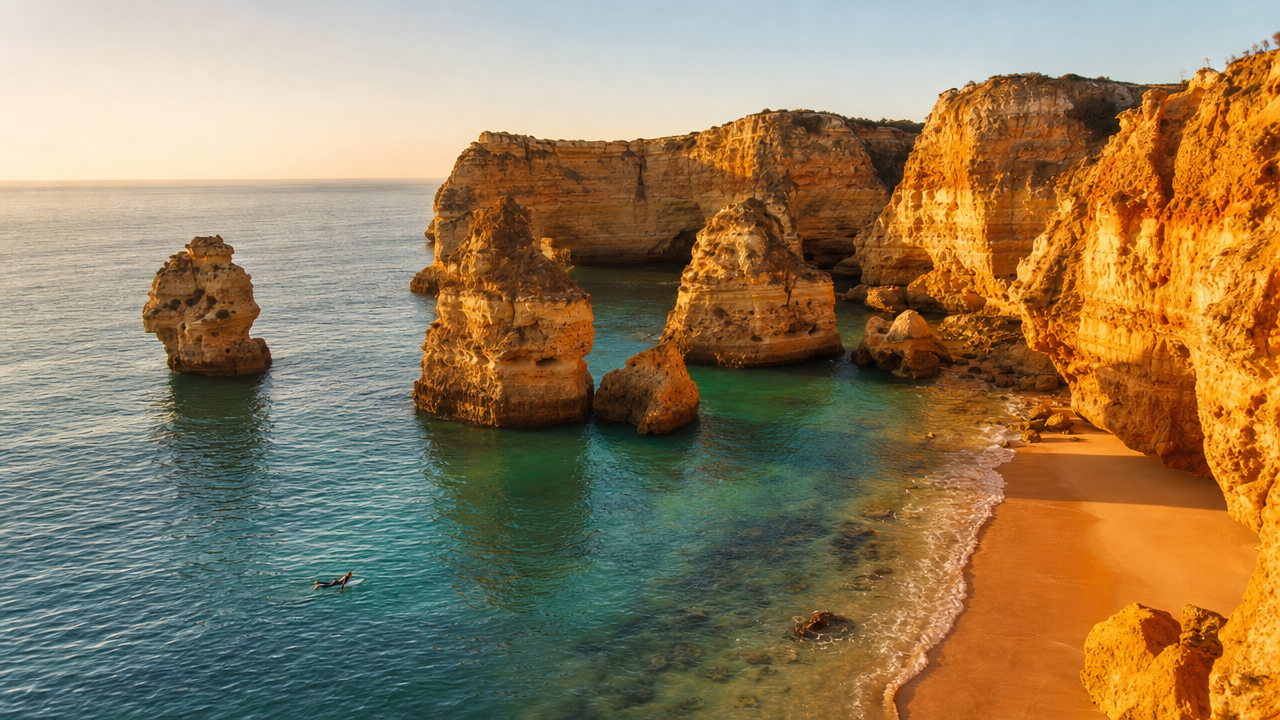
Praia da Marinha is one of the most photographed beaches in Portugal, and for good reason. The limestone cliffs are sculpted into dramatic arches and sea stacks, and the water is a shade of blue that looks doctored. The surf here is inconsistent — it needs a significant south swell to wrap around the cape — but when it does, the right-hand point break that forms off the eastern end of the beach is a thing of beauty. Long, gentle walls that peel for 100 metres or more, with beautiful cliff scenery as your backdrop. It's a longboarder's dream.
Praia do Vale do Centeanes (often just called "Carvoeiro" by locals) is a small beach tucked into a cove in the town of Carvoeiro. The break is a left-hand reef that works on a south swell, and it's generally only rideable when the swell is over 1.5 metres. Below that, it's a lovely swimming beach. Above that, it's a fun, punchy wave that will test your pop-up timing.
Arrifes Beach near Albufeira is another south-coast spot that occasionally lights up. The wave is a right-hand point that breaks over a rocky reef, and it's one of the few south-coast breaks that can handle a bigger swell without closing out. The paddle out is a mission — you'll need to scramble over rocks and paddle through a narrow channel — but the locals are protective of this spot, and for good reason. It's a gem.
Faro Beach (Praia de Faro) is the closest surf break to the region's main airport, and it's a popular spot for a quick session between flights. The beach faces south, so it needs a south or southwest swell to work, but when it does, the waves are clean and forgiving. The beach is connected to the mainland by a bridge, and there's a large car park, a handful of restaurants, and a surf school on site. It's not the most dramatic setting on the Algarve, but it's convenient and functional.
Surf Schools & Camps
The Algarve is one of the best places in Europe to learn to surf. The combination of beginner-friendly waves, warm water (by European standards), and a deep surf culture means there are dozens of schools and camps to choose from. Here are the ones worth booking.
Sagres Natura in Sagres is the gold standard. They run week-long surf camps with accommodation, meals, daily coaching, and video analysis. The instructors are all Portuguese, most of them have been surfing the local breaks since childhood, and they have a knack for getting beginners up and riding in their first session. Prices start at around €550 for a week in a shared room, including all meals and equipment. Their breakfasts are legendary — fresh bread, cheese, ham, fruit, and coffee that's strong enough to wake the dead.
Algarve Surf School is based on Meia Praia in Lagos and is one of the largest schools in the region. They offer everything from a single two-hour lesson (€40) to a week-long camp (€400–500 without accommodation). They also run women-only sessions and intermediate clinics that focus on turns and wave selection. The instructors speak excellent English, and the equipment is well-maintained. The only downside is the group sizes — during peak season, you can end up in a class of 12 or more.
Surfing Sagres is a smaller, more boutique operation. They cap their groups at 6 students per instructor, and they focus on getting you into the right wave for your level rather than running a production line. A week-long camp with accommodation costs around €650, and they also offer standalone coaching sessions for experienced surfers who want to dial in their technique.
Baleal Surf Camp operates out of Baleal, a small surf town north of Peniche. While the focus here is on the surf spots in Portugal beyond the Algarve — like Peniche and Ericeira — many of their camps include a week in the Algarve as part of a longer itinerary. If you're planning a longer trip, this is a good option to see multiple regions without the hassle of organising everything yourself.
Da Wave Surf School in Faro is the best option if you're flying in and out of Faro Airport and want to get straight in the water. They offer pick-up from the airport, equipment hire, and lessons for all levels. Their south-coast location means they're constrained by swell direction, but they know the region well and will take you to the best working break on any given day.
Lagos Surf School runs a tight operation on Meia Praia. They're particularly good with absolute beginners — their instructors are patient, the boards are soft and forgiving, and the waves at Meia Praia are gentle enough that you won't feel intimidated. The prices are reasonable — €35 for a two-hour lesson, €60 for a full-day session.
Prices for surf camps in the Algarve range from about €350 for a basic week without accommodation to €800+ for a premium camp with private rooms, video coaching, and meals. Most camps run from Sunday to Saturday, and the best ones will pick you up from the airport if you ask.
When Is the Best Time to Surf the Algarve?
The Algarve is a year-round surf destination, but the quality and consistency of the waves change dramatically with the seasons.
Winter (November–February) delivers the largest and most consistent swells to the Algarve coast, with west coast breaks regularly producing waves reaching 3 to 4 metres that attract experienced surfers from across Europe. During these months, water temperatures drop to 14 to 16 degrees Celsius, requiring a full 4/3 millimetre wetsuit, boots, and often a hood, while air temperatures hover between 10 and 15 degrees Celsius with persistent north-westerly winds. The trade-off for braving the cold is substantial: crowds thin dramatically, with even the most popular breaks like Tonel and Beliche quiet on weekdays, and accommodation prices dropping by 50 percent or more compared to peak summer rates. This combination of powerful Atlantic swells, uncrowded lineups, and reduced costs makes winter the prime season for experienced surfers who prioritise wave quality over warm weather. For those properly equipped, the winter Algarve offers some of the most consistent and challenging surf in continental Europe, rewarding local knowledge and preparation.
Spring (March–May) is the sweet spot for many. The swells are still consistent, the water is warming up (16–18°C), and the weather is more settled. The crowds are manageable, and the accommodation is still reasonably priced. The south coast starts to pick up smaller swells, so beginners have more options. This is probably the best time for a surf trip that balances good waves with comfortable conditions.
Summer (June–August) is the busiest and most expensive time to visit. The west coast gets smaller swells — generally 1–2 metres — and the south coast can go flat for weeks. The water temperature peaks at 20–22°C, so a 3/2 wetsuit or even a shorty is enough. The crowds are intense, especially at the popular beginner spots. Accommodation prices are at their peak, and if you don't book months in advance, you'll struggle to find a bed in Sagres or Lagos. The trade-off is that the weather is beautiful, the evenings are long, and the towns are buzzing. For beginners who want warm water and don't mind small waves, summer is fine.
Autumn (September–October) is widely considered the best season for surfing in the Algarve. The water is still warm from summer (18–20°C), the swells start to pick up again, and the crowds thin out after the September rush. The weather is usually settled, with long sunny days and light winds. If you can only come for one week, aim for late September or early October. It's the best time to visit Portugal for a surf trip.
The wind is a critical factor in the Algarve. The prevailing wind is north to north-west, which is offshore for the south coast and onshore (or cross-shore) for the west coast. The best time to surf the west coast is usually early morning, before the wind picks up. The south coast works well in the afternoon, when the north wind is offshore and the waves are clean.
Where to Stay
Accommodation in the Algarve ranges from cheap hostels to luxury resorts, and the best option for you depends on where you're surfing and what kind of trip you're having.
Sagres is the surfers' base camp. The town has a handful of surf hostels, including Sagres Surf House and Sagres Lodge, both of which offer dorm beds (€20–30/night), private rooms (€50–80/night), and a social atmosphere that's perfect for solo travellers. The more budget-conscious can stay at Sagres Camping, a well-run campsite just outside town with pitches for tents (€10/night) and campervans (€15/night), plus a pool and a bar. For a bit more comfort, Mareta View is a boutique hotel with clean rooms, a great breakfast, and a rooftop terrace that overlooks the town. The best camping spots in Portugal are further north along the west coast, but Sagres Camping is a solid option for surfers on a budget.
Lagos has a wider range of accommodation. The Lagos Surf Hostel is the best budget option for surfers, with a lively atmosphere and a partnership with Algarve Surf School. Private apartments on Meia Praia are widely available through Airbnb and Booking.com, and prices drop significantly outside the summer months. For a mid-range option, the Tivoli Lagos is a four-star hotel in the old town that's comfortable and well-located.
Carvoeiro is quieter and more family-oriented. The Vila Nova Hotel is a good mid-range option, and the Carvoeiro Surf Camp runs a dedicated surf lodge with dorm and private rooms. It's a good base if you're focusing on the south coast breaks.
Faro is the most practical option if you're flying in and out of the airport and want to minimise travel time. The AP Eva Senses is a four-star hotel on the waterfront that's comfortable and reasonably priced. The Faro Surf Hostel is a cheaper option with a surfer vibe.
Peniche and Ericeira are further north, but they're worth mentioning because they're the other major surf hubs in Portugal. If you're planning a road trip, you can easily combine a week in the Algarve with a week in Peniche or Ericeira. The surf towns in Portugal are all connected by good roads, and the drive from Sagres to Peniche is about 3 hours.
Beyond the Surf
The Algarve is a surf destination first, but it's also a region with a rich culture, incredible food, and landscapes that are worth exploring on land.
The Ria Formosa Natural Park is a protected lagoon system that stretches from Faro to Tavira. It's a birdwatcher's paradise, with flamingos, spoonbills, and egrets wading through the salt pans. Kayaking through the lagoon is a peaceful way to spend a rest day, and the beaches on the barrier islands — like Ilha Deserta and Ilha da Culatra — are some of the most pristine in the country.
The Vicentine Coast Natural Park runs from Sagres up the west coast to the Alentejo. It's a protected area of cliffs, dunes, and heathland, crisscrossed by hiking trails that offer breathtaking views of the Atlantic. The Fishermen's Trail (Rota Vicentina) is a multi-day hike that follows the coastline from Sagres to Porto Covo, and it's one of the best coastal walks in Europe. Even if you're not a hiker, a short walk along the cliffs above Praia do Tonel is worth it for the sunset.
The food in the Algarve is excellent. The region is famous for its seafood — grilled sardines (sardinhas assadas), octopus salad (salada de polvo), and the local cataplana, a seafood stew cooked in a copper pot. The peri-peri chicken is also a staple, and the best places are the roadside grills that look like nothing from the outside but serve the best chicken you've ever eaten. The wine is good too — the Vinho Verde from the north is widely available, but the local Algarve wines are worth trying, especially the white wines from the Lagoa region.
The people are the best part of the Algarve. The Portuguese are famously hospitable, and the surf community is no exception. The older generation of surfers in Sagres remembers when the town was a quiet fishing village with a handful of visiting surfers. They're proud of how the surf culture has grown, and they're happy to share their waves with visitors who show respect. Learn a few words of Portuguese — "obrigado" (thank you), "bom dia" (good morning), "boas ondas" (good waves) — and you'll be welcomed.
Final Thoughts
The Algarve is not a secret. It's been on the European surf map for decades, and the crowds are growing every year. But the region is big enough, the coastline is varied enough, and the surf culture is deep enough that it still has the feel of a discovery. You can find waves that are completely empty if you're willing to walk. You can find a cliffside café with a view that stops you mid-sentence. You can find a wave that is just yours, for a moment, before the next set rolls in.
The best advice I can give is this: don't over-plan. The Algarve rewards flexibility. If the wind is howling on the west coast, drive to the south coast. If the swell is too big for your level, find a sheltered cove. If you hear about a beach that's firing, go. The best sessions are the ones you didn't plan for.
And when you're standing on the cliff at Sagres, watching the sun set over the Atlantic, with a surfboard under your arm and salt in your hair, you'll understand why the Algarve has been calling surfers to its shores for generations.
Boas ondas.
Recommended Gear
We may earn a commission if you purchase through these links, at no extra cost to you. We only recommend products we genuinely use and trust.
Rip Curl Flashbomb 4/3
Rip CurlPremium 4/3mm wetsuit for winter surfing in Portugal and Morocco. E5 neoprene provides excellent flexibility.
~$350-$450Torq Longboard 8'0"
TorqBeginner-friendly epoxy longboard. Stable, buoyant, and perfect for learning in Taghazout's gentle waves.
~$500-$700World Nomads Explorer
World NomadsComprehensive travel insurance that covers trekking above 3,000m, surfing, and camping. Trusted by outdoor travellers.
~$50-$150