Cabo Verde (Cape Verde) is a volcanic archipelago of ten islands (nine inhabited) suspended in the North Atlantic roughly 460 km off the coast of Senegal. It is a place where the desert meets the ocean, where volcanic peaks rise above lush green valleys, and where the trade winds blow almost without pause — creating conditions that make it one of the most exciting year-round outdoor destinations in the Atlantic.
The islands split naturally into two groups: the Barlavento (windward) islands — Santo Antão, São Vicente, Santa Luzia, São Nicolau, Sal and Boa Vista — and the Sotavento (leeward) islands — Maio, Santiago, Fogo and Brava. Each has its own personality. Sal and Boa Vista are flat, dry and ringed with white-sand beaches; they draw surfers, kitesurfers and sun-seekers. Santo Antão and Fogo rise high and green, carved by erosion into hiking country that rivals the best in Macaronesia. Santiago holds the capital, Praia, and Cidade Velha, a UNESCO World Heritage site that was the first European settlement in the tropics.
The climate is dry subtropical, with daytime temperatures hovering between 22°C and 30°C year-round. The sea stays warm — 22–27°C — making swimming, snorkelling and diving possible in every month. The motto is "No Stress," and the pace of life follows suit: hammocks, fresh grilled fish, and a music scene built on morna and funaná that runs deep into the night.
This guide covers everything you need to plan a trip: the best outdoor activities, where to go and when, sample itineraries, visas, transport, budgeting and how to travel responsibly.
Top Outdoor Activities
Cabo Verde's geography — volcanic mountains, wind-scoured coasts, clear warm waters and isolated Atlantic position — makes it a natural playground for five distinct outdoor pursuits.
Surfing
The archipelago catches swell from both the North and South Atlantic, giving it a year-round surf season. Sal and Boa Vista are the principal surf islands.
- Santa Maria Beach (Sal) delivers reef and beach breaks with lefts and rights suitable for intermediates and above. The famous Fonteia reef produces powerful waves for experienced surfers when the swell is up.
- Boa Vista's open Atlantic exposure yields powerful breakers. The remote Amílcar Cabral spot is legendary among big-wave riders.
- For beginners, Santa Maria's gentler inside sections and Rabil (Boa Vista) offer mellow waves with surf schools to guide you.
The best waves roll in from November to March, but there is surfable swell in every month. Dozens of surf camps and schools operate on both islands, many offering all-inclusive packages with accommodation, meals and daily coaching.
Kitesurfing & Windsurfing
Cabo Verde is one of the world's great kitesurfing destinations. The trade winds blow consistently from October through April, creating ideal conditions on both Sal and Boa Vista.
Santa Maria Bay (Sal) is the hub: strong side-shore winds virtually guarantee riding conditions through the winter months. The GKA Kite World Tour holds events at Ponta Preta (Sal) and Praia de Chaves (Boa Vista). Kiteboarding legend Airton Cozzolino calls Sal home and teaches at local schools. Even on off-wind days, the water stays warm enough for snorkelling, and the beach bars provide a fine consolation prize.
Hiking & Trekking
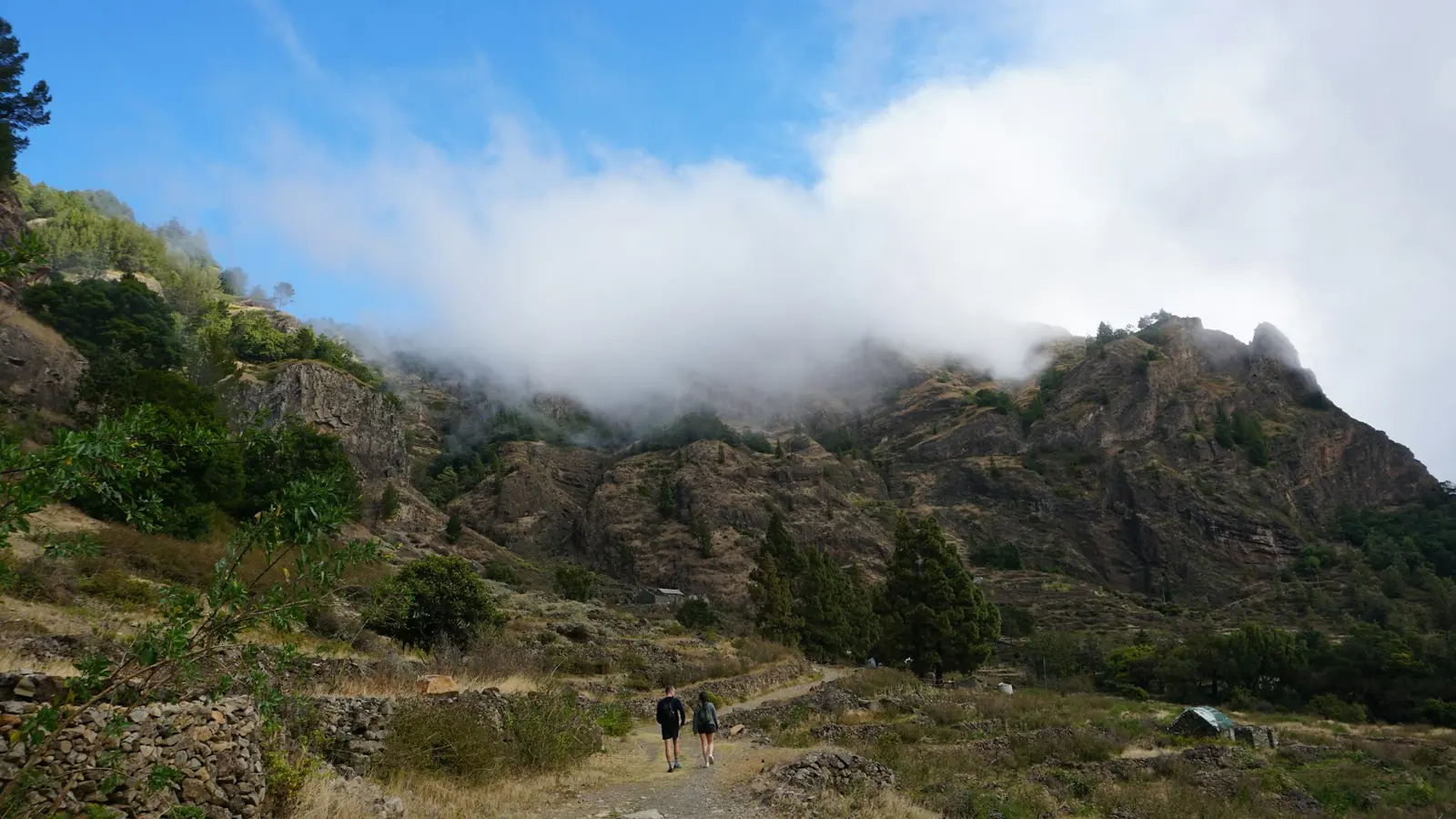
For hikers, Santo Antão is the undisputed jewel. The island's volcanic spine rises to nearly 2,000 m, and centuries of erosion have carved deep, lush valleys that descend to the sea. The signature route is the Cova Crater → Ribeira Paul hike, a full-day trek that drops from the crater rim through terraced fields and tiny villages to the valley floor. The coastal trail from Cruzinha to Fontainhas to Ponta do Sol is shorter but equally dramatic, hugging cliffs with vertiginous views of the Atlantic.
On Fogo, the highlight is Pico do Fogo (2,829 m), the tallest peak in Cabo Verde and an active volcano. The guided overnight trek starts in the crater village of Chã das Caldeiras and summits before dawn for sunrise views over the island and the sea beyond. The terrain is lunar — black lava fields contrast sharply with the deep blue Atlantic.
Santiago offers easier walks such as the Calabaceira to Cidade Velha trail, which descends through green hills to the historic old capital. São Vicente's Monte Verde and São Nicolau's Monte Gordo Natural Park provide shorter day-hike options with panoramic island views.
Scuba Diving & Snorkelling
Cabo Verde sits at a marine crossroads where warm tropical currents meet cooler Atlantic waters. Visibility typically ranges from 20 to 40 m, and water temperatures sit at 22–27°C year-round.
Sal has the most developed dive infrastructure. Top sites include Buracona Cave — a 26 m cavern whose "Blue Eye" opening creates dramatic shafts of light — and several wrecks off Palmeira Harbour. Boa Vista is known for large marine life: sea turtles, rays, and whale sharks (best June–November). The northern islands of São Vicente and Santo Antão offer wall dives and wreck dives (the Mindelo Bay wreck and a cargo ship off Santo Antão are popular).
The best dive season runs April to November, when seas are calmest, but year-round diving is possible with a thicker wetsuit in winter. Snorkellers should head to Murdeira Bay (Sal) for calm turtle encounters, the shallows of Ponta Preta, or early-morning at Praia de Chaves (Boa Vista) for sea turtle sightings.
Birdwatching
As a Macaronesian archipelago, Cabo Verde hosts approximately 298 bird species, including several endemics. Key species include the Cape Verde Warbler, Alexander's Swift, Raso Lark and Iago Sparrow. The valleys of São Nicolau and Santo Antão, coastal lagoons on Sal and Maio, and mineral-rich lagoons on Santiago and Boa Vista all attract waterbirds and waders. The islands are also a crucial nesting ground for seabirds, including the Cape Verde Shearwater.
Birding is best combined with hiking or snorkelling. Local guides can help spot warblers and endemic sparrows in the interior valleys, particularly around Paul Valley on Santo Antão.
Curated Locations & Beaches
| Location / Beach | Island | Coordinates | Best For |
|---|---|---|---|
| Santa Maria Beach | Sal | 16.599°N, 22.904°W | Surfing, kitesurfing, nightlife |
| Ponta Preta Beach | Sal | 16.606°N, 22.930°W | Surfing, sunset views |
| Buracona Lagoon | Sal | 16.763°N, 22.904°W | Diving ("Blue Eye" cave), snorkelling |
| Morro de Areia (Chaves) | Boa Vista | 16.113°N, 22.916°W | Snorkelling, turtle encounters |
| Praia de Santa Mónica | Boa Vista | 16.044°N, 22.831°W | Surfing, long beach walks |
| Ponta do Sol / Fontainhas | Santo Antão | 17.160°N, 25.055°W | Hiking (coastal trail), photography |
| Valley of Paúl | Santo Antão | 17.104°N, 25.110°W | Hiking (crater-to-valley descent) |
| Tarrafal Beach | Santiago | 15.278°N, 23.752°W | Volcanic sand beach, snorkelling |
| Cidade Velha (UNESCO) | Santiago | 14.918°N, 23.513°W | Cultural sightseeing (fort, church) |
| Baía das Gatas | São Vicente | 16.911°N, 24.984°W | Lagoon swimming, annual music festival |
| Monte Verde | São Vicente | 17.044°N, 24.915°W | Hiking (island summit viewpoint) |
| Fogo Volcano (Pico) | Fogo | 14.950°N, 24.353°W | Volcano trekking (requires guide) |
| Cova Natural Park | Santo Antão | 17.053°N, 25.070°W | Crater rim viewpoint, hiking |
Sample Itineraries
3-Day Island Hopping
Day 1: Arrive Sal (Amílcar Cabral Airport). Settle into Santa Maria, take a surf or kite lesson on the beach. Evening drinks at a Ponta Preta sunset bar.
Day 2: Morning flight to Santiago. Hike the Calabaceira → Cidade Velha trail through green hills to the UNESCO old town. Explore the fort, the church and the pillory square. Night in Praia.
Day 3: Ferry to São Vicente. Morning snorkel at Baía das Gatas lagoon. Afternoon exploring Mindelo's colonial streets and live music scene. Depart from São Vicente's airport (VXE) or return via ferry + flight.
7-Day Adventure
| Day | Itinerary |
|---|---|
| 1 | Arrive Sal — Santa Maria Beach (kite/surf); sunset at Ponta Preta |
| 2 | Sal — Buracona "Blue Eye" snorkel; evening flight to Boa Vista |
| 3 | Boa Vista — Viana Desert 4×4; Praia de Chaves turtle beach; night in Rabil |
| 4 | Boa Vista — sunrise turtle tour; late ferry to São Vicente; Mindelo promenade |
| 5 | São Vicente — day hike Monte Verde; afternoon Baía das Gatas lagoon swim |
| 6 | Early ferry to Santo Antão — hike Cova Crater → Paúl Valley; return ferry |
| 7 | Morning flight to Santiago — Tarrafal Beach swim; afternoon drive to Cidade Velha; depart |
10-Day Grand Circuit
Follow the 7-day itinerary above, then add:
Days 8–9: Fly to Fogo. Overnight in the crater village of Chã das Caldeiras. Summit Pico do Fogo before dawn for the sunrise view over the volcano and the Atlantic. Descend and explore São Filipe's colonial town.
Day 10: Fly to Maio for a relaxed final day — uncrowded beaches, lagoon snorkelling at Baía das Mujas, and a quiet lunch before departing. Fly out via Santiago or Sal.
Getting There & Around
International Flights
Cabo Verde has four international airports: Praia (RAI) on Santiago, Sal (SID), Boa Vista (BVC) and São Vicente (VXE). Major carriers include Cabo Verde Airlines (TACV), TAP Portugal (via Lisbon), Royal Air Maroc (via Casablanca), Binter Canarias (via the Canary Islands) and EasyJet (new routes added Winter 2025/26). Direct flights from the US are limited; most travellers connect through Lisbon or Casablanca.
Inter-Island Travel
CVSky, launched in April 2026, operates regional ATR flights connecting Santiago, São Vicente, São Nicolau, Sal, Boa Vista and Fogo. Flight times are short (30–60 minutes). Book ahead for reliability.
Ferries (CV Interilhas) link Santiago–Santo Antão and Sal–Boa Vista, but conditions can be rough — seasickness is common on the open-water crossings. Flying is recommended for longer inter-island hops, especially to Fogo, Maio and Brava.
On-Island Transport
Taxis and rental cars are available at airports and in major towns. Car hire costs roughly €70–120 per day. Roads can be narrow and steep, especially on Santiago and Santo Antão; avoid driving after dark. For budget travel, aluguers (shared minibuses) serve routes between towns, typically costing €1–2 per short hop.
Visa & Entry Requirements
Most visitors (EU, US, UK, Canada, Australia, Japan, Brazil and many others) do not need a visa for stays up to 30 days. However, all visitors must pre-register on the EASE portal (www.ease.gov.cv) and pay an Airport Security Tax (currently 3,400 CVE, approximately €30) up to 5 days before arrival or on arrival. Passports must be valid for at least six months beyond the date of entry.
A yellow fever vaccination certificate is required if arriving from an affected country (e.g. Senegal). No other mandatory vaccinations apply, but Hepatitis A and typhoid are recommended. Cabo Verde is malaria-free.
Best Time to Visit
Cabo Verde is a year-round destination. The climate breaks down as follows:
| Activity | Best Season | Notes |
|---|---|---|
| Surfing / Kitesurfing | October – April | Consistent trade winds and Atlantic swell |
| Snorkelling / Diving | May – October | Calmest seas; whale sharks Jun–Nov; humpbacks Jan–Apr |
| Hiking | November – March | Cooler temperatures; minimal rain |
| Birdwatching | April – May, September – October | Spring and autumn migrations; turtle nesting Jul–Oct |
| Beach / General | December – February | Peak tourist season; book ahead |
| Budget travel | April – June, September – October | Shoulder seasons; lower prices, good conditions year-round |
Safety & Health
Cabo Verde is one of the safest countries in Africa. The US State Department rates it Level 1 (exercise normal precautions), comparable to Western Europe. Violent crime is rare, but petty theft and pickpocketing occur in cities — keep valuables secure and avoid displaying wealth, especially in Praia and Mindelo after dark.
Natural hazards: Strong coastal currents and rip tides exist on many beaches. Swim in flagged areas or with a guide. Wear water shoes on rocky bottoms to avoid sea urchins and coral cuts.
Health: Tap water is chlorinated on Sal, Boa Vista and Santiago; use bottled water on other islands. No malaria risk. Sunscreen, plenty of water and insect repellent (for mosquitoes in greener areas) are the main essentials.
Emergency numbers: 130 (medical), 132 (police), 131 (fire).
Cost & Budget Estimates
Cabo Verde is more affordable than Europe but pricier than mainland West Africa. A 7-day moderate budget (excluding international flights) runs approximately €1,500 per person. Here is a rough breakdown:
| Category | Budget | Mid-range | Luxury |
|---|---|---|---|
| Accommodation (per night) | €15–40 (hostel / guesthouse) | €50–100 (3★ hotel) | €120–450 (resort) |
| Meals (per day) | €10–15 (local eateries) | €25–35 (mid-range restaurants) | €50+ (fine dining) |
| Local transport (per day) | €2–5 (aluguers) | €15–30 (taxis / rental) | €30+ (private driver) |
| Activities (per day) | Free (beach / hike) | €40–100 (dive / surf lesson) | €100+ (guided tours) |
Carry euros — they are widely accepted for payment, though change is given in escudos (CVE). ATMs are common in cities.
Accommodation by Island
- Sal: Santa Maria is the tourist hub with a wide range of hotels, surf camps and resorts. Budget rooms from €50, luxury up to €450.
- Boa Vista: Sal Rei area concentrates most resorts and all-inclusive hotels. Praia de Chaves has mid-range options.
- Santiago: Praia has mid-range hotels and a few hostels. Tarrafal has small pensions near the beach.
- São Vicente: Mindelo offers charming pousadas and apartments (€50–80 per night).
- Fogo: São Filipe has guesthouses; the crater lodge at Chã das Caldeiras (book months ahead) is the only accommodation on the volcano.
- Santo Antão & Maio: Limited formal hotels. Most visitors stay in guesthouses or return to São Vicente for lodging.
Local Culture, Language & Food
Cape Verdean culture is a blend of African, Portuguese and Brazilian influences. Music is everywhere: the melancholy morna (made famous by Cesária Évora), the upbeat funaná and the electronic coladeira all find a home in the bars of Mindelo and Praia.
Language: Portuguese is the official language, but Cape Verdean Creole (Kriolu) is spoken at home. English is understood in tourist areas. A few words of Kriolu — "Obrigadu" (thank you, male speaker), "Nha amigu" (my friend) — go a long way.
Food: The national dish is cachupa, a slow-cooked stew of beans, maize, cassava, sweet potato, and fish or meat. Grilled tuna and lobster are regional specialities. Street bars serve pastel (savoury pastries) and grogue, the local sugarcane rum.
Sustainable & Responsible Travel
Cabo Verde's environment is fragile. The islands are dry — water conservation matters. Take short showers, refill a reusable bottle and avoid single-use plastics.
- Turtle nesting (July–October): Keep beaches dark at night, do not use flash photography, and maintain distance. Book turtle-watching tours with reputable operators only.
- Marine life: Do not touch coral, reef life or turtles while snorkelling or diving. Use reef-safe sunscreen.
- Hiking: Stick to marked trails to prevent erosion. Take all rubbish with you.
- Local economy: Hire Creole-speaking guides, eat at family-run restaurants, buy handicrafts from local artisans, and choose eco-certified accommodation where available.
Photography Highlights
Cabo Verde is a photographer's destination. The green valleys of Santo Antão against the deep blue Atlantic, the black lava fields of Fogo's crater, the turquoise shallows of Santa Maria, and the colonial architecture of Mindelo and Cidade Velha all reward a camera. Early mornings on Boa Vista's beaches yield sea turtle encounters; sunsets from Ponta Preta are reliably spectacular.
Related Guides & Pages
- Destinations: Cabo Verde — Country overview with all locations, activities and travel details.
- Activities: Surfing — Surf spots across Morocco, Spain, Portugal and beyond.
- Activities: Hiking — Trail guides for every level, from valley walks to volcano summits.
Frequently Asked Questions
Do I need a visa for Cabo Verde?
No visa is needed for EU, US, UK, Canadian, Australian, Japanese or Brazilian citizens for stays up to 30 days. All visitors must pre-register on the EASE portal (www.ease.gov.cv) and pay an airport security tax of approximately €30.
What is the best time to visit?
Year-round, but October–April is best for surfing and kitesurfing, May–October for diving, and November–March for hiking. December–February is peak tourist season.
Is Cabo Verde safe?
Yes — Level 1 (exercise normal precautions) per the US State Department. Petty theft occurs in cities; strong currents exist on some beaches. Overall it is one of the safest destinations in Africa.
What currency do I need?
The Cape Verdean Escudo (CVE). Euros are widely accepted for payments, but change is given in escudos. ATMs are common in Praia, Mindelo, Santa Maria and Sal Rei.
Is English widely spoken?
In tourist areas — Santa Maria, Sal Rei, Praia, Mindelo — yes. In rural areas, Portuguese and Creole dominate. Learning a few Creole phrases is appreciated.
Can I island-hop easily?
Yes. CVSky (regional flights) connects the main islands. Ferries are cheaper but rougher. For a 7-day trip, stick to 3–4 islands; for 10 days, you can add Fogo.